
Tuber excavatum
Taxonomy
Main synonym
Common names
trufa excavada
Geographic references:
Interactive map with data from GBIF.

Morphological Features:
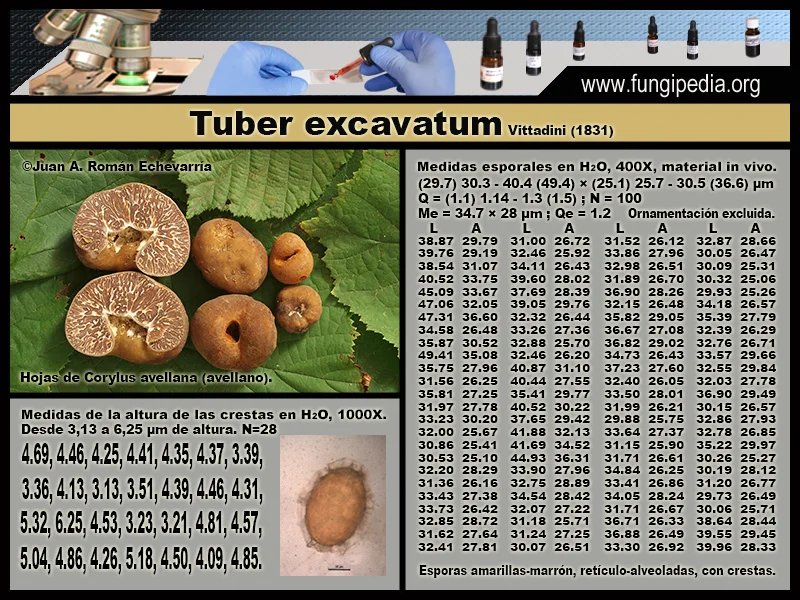
Carpophore with the small tuber-like shape typically found in species of the genus Tuber, highly irregular, usually bearing protuberances, sometimes grooved from the base, and may even appear lobed. A significant feature in this species is the presence of a broad basal cavity that can become quite deep, extending even into the gleba. Its color is quite variable, with yellowish-ochre specimens predominating, darkening considerably with age. Regarding size, specimens between 2 and 4 cm in diameter are most common, although some exceptionally exceed 7 cm.
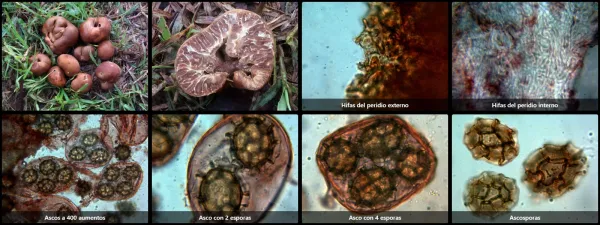
Peridium external pseudoparenchymatous, yellowish-ochre in color, firmly attached to the gleba, smooth to the touch but soft, lacking hairs; the internal peridium is thicker than the external one, formed by a series of interwoven hyphae cemented together (plectenchymatous).
Gleba evolves according to the maturity stage of the specimen, ranging from yellowish-ochre to dark brown tones at full maturity, featuring white or yellowish-cream venulations that may exhibit a radial arrangement from the base, although this is a somewhat variable or random characteristic.
Flesh of extremely hard consistency, very difficult to section for microscopic study, with a generally quite pleasant odor, mildly truffle-like with a nutty nuance, except in highly mature specimens where it becomes unpleasant, and with an insignificant taste.
Habitat:
We are dealing with a very common hypogeous species in our forests, which fruits on calcareous soils, and for which numerous habitats have been recorded, particularly under various broadleaf trees. We have collected it under beech (Fagus sylvatica), holm oak (Quercus ilex), and also under hazel (Corylus avellana), with a wide distribution across Bizkaia as well as the neighboring provinces of Álava, La Rioja, and Burgos. It can appear practically year-round if conditions are favorable, and often in considerable abundance.
Observations:
Not all truffle species placed within the genus Tuber are edible; this is a clear case of a completely inedible truffle due to the extreme hardness of its flesh. It is characterized, in addition to its hardness, by its broad basal cavity and yellowish-ochre coloration. It may be confused with the species Tuber fulgens, which is much less common, has a more reddish hue, features orange mycelial hyphae that frequently appear near the basal cavity, and possesses more spherical spores. Several varieties of this species have been described based on color differences that represent merely ecological forms of the same taxon.
Microscopy of Tuber excavatum