
Favolaschia claudopus
Taxonomy
Main synonym
Common names
Not available
Geographic references:
Interactive map with data from GBIF.


Morphological Features:
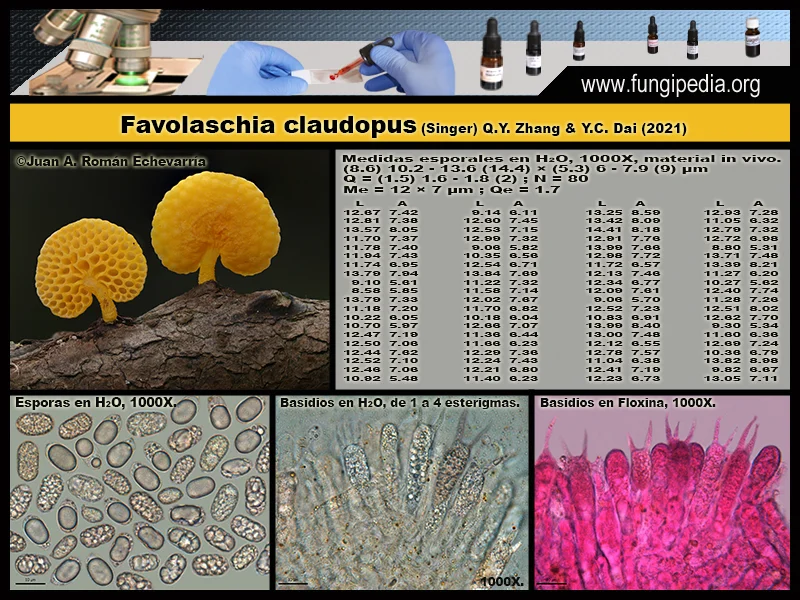
Pileus of very small size; we have observed specimens approaching 2 cm, but the vast majority range between 0.5 and 1.5 cm. In the primordium stage, they are somewhat convex and exhibit a whitish pruina on the pileipellis. Upon development, they quickly assume a variable expanded shape, sometimes fan-like, or kidney- or heart-shaped when viewed from above, with the pruina washing away in rain. Due to its translucency, the shape of the pores is faintly visible through the cuticle. Fresh and young specimens display a very vivid and striking lemon-yellow coloration, which shifts to equally bright orange tones as they dry.
Tubes Unlike species in other orders such as Boletales or Polyporales, true tubes are absent here. The hymenium of this species is alveolate; while one might generously describe it as porous, it definitively lacks tubes.
Pores or alveoli forming the fertile portion of the basidiocarp are broad with very thin walls and angular, collectively resembling a honeycomb structure. They share a yellow coloration similar to that of the pileus.
Stipe Very short, sometimes inconspicuous measuring only 1–2 mm and embedded in the substrate; it rarely exceeds 5 mm in length. Regarding its position, it is never central, being either eccentric or directly lateral. Its color matches the rest of the basidiocarp (yellow), and it may occasionally be somewhat pruinose.
Flesh Virtually absent. It lacks a distinctive odor; the species is completely tasteless and odorless, with a somewhat gelatinous texture.
Habitat:
This is a saprotrophic species that feeds on decaying organic matter; it is fundamentally a wood-decay fungus. In our region, it can be found on fallen branches or logs of various tree species. It is an alien and invasive species that has been proliferating alarmingly in recent years, making encounters with it increasingly common. It typically fruits gregariously, with numerous specimens on a single branch, generally during autumn, though not exclusively.
Observations:
This species is characterized by its small size, its beautiful lemon-yellow coloration throughout the basidiocarp, and its alveolate hymenium. Initially, specimens of this species found in our region were classified as Favolaschia calocera, with Favolaschia claudopus considered a variety thereof. However, a 2021 taxonomic revision of the genus clarified that Favolaschia claudopus is a distinct species. Furthermore, phylogenetic studies have confirmed that specimens occurring in our region correspond to Favolaschia claudopus, a species of Australian origin.
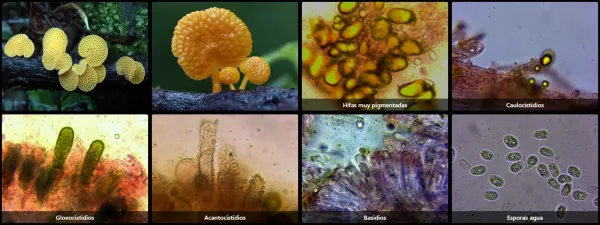
Microscopy of Favolaschia claudopus