Tuber fulgens
Taxonomy
Main synonym
Common names
Not available
Geographic references:
Interactive map with data from GBIF.



Morphological Features:
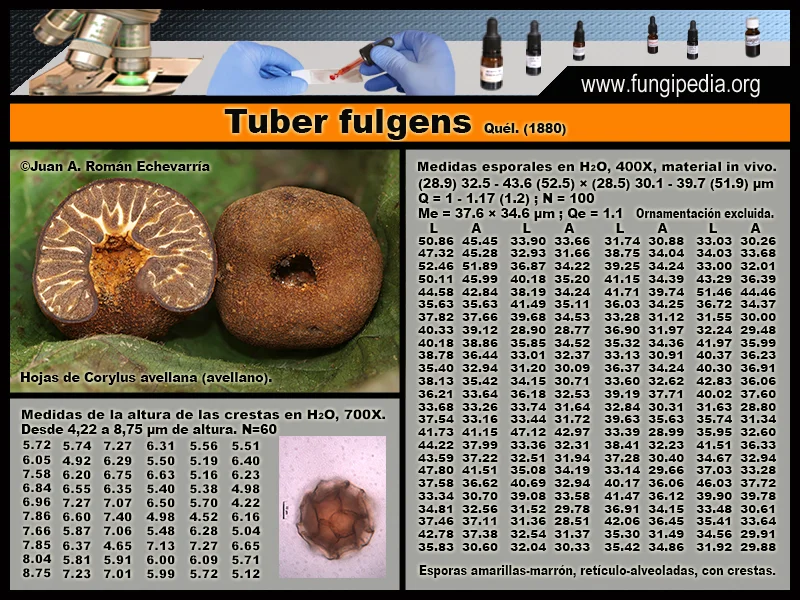
Fruiting body resembling a small potato or tuber, as is typical for most hypogeous fungi; it exhibits a medium size for the genus, with most collected specimens measuring between 2 and 4 cm in diameter, occasionally reaching larger sizes. Its shape may be globose to subglobose but simultaneously quite irregular, potentially bearing protuberances or longitudinal grooves, and it may even become lobed. Fresh specimens exhibit a reddish-brown color that gradually shifts to more distinctly brown or ochre tones upon drying. At the base, it possesses a characteristic cavity that can be deep and extend into the gleba, displaying orange or saffron hues derived from the mycelium within.
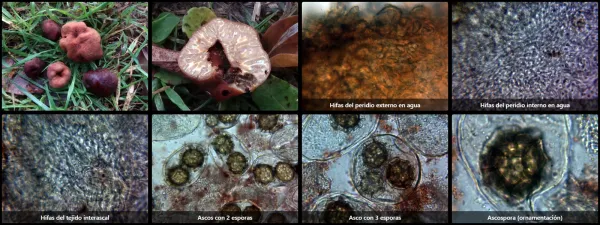
Peridium External reddish-brown and covered with wart-like papillae; pseudoparenchymatous, glabrous, lacking hairs, and smooth to the touch. The internal peridium is plectenchymatous, composed of aggregated hyphae and thicker than the external layer.
Gleba Compact and extremely hard, orange-ochre in young specimens, becoming more distinctly ochre or even brown with age. It features whitish veins that remain unchanged upon maturation and do not necessarily exhibit a radial arrangement, only occasionally.
Flesh Of extreme hardness, very difficult to slice or cut with a knife. It possesses an odor that is pleasant and mildly truffle-like in young specimens, but becomes unpleasant upon maturation, with a rather insignificant taste.
Habitat:
This is a hypogeous species that fruits in calcareous forests, generally associated with various broadleaf trees. In our case, it was specifically collected in a mixed forest of beech (Fagus sylvatica) and hazel (Corylus avellana) in the province of Álava. It is a sparsely recorded species on the peninsula and considered rare, by no means occurring with the abundance of the very similar Tuber excavatum. We do not believe it shows a preference for a specific time of year, as the few records are scattered throughout the year; our collection was made in October.
Observations:
Despite lacking an unpleasant odor when young, the extreme hardness of the flesh renders this species completely inedible. It is characterized, besides its hardness, by a reddish-brown warty peridium and a deep basal cavity where orange mycelial hyphae are visible. It shares numerous similarities with the species Tuber excavatum; in fact, it was long mistakenly considered a variety thereof. However, phylogenetic studies have demonstrated that they are two distinct species. Tuber excavatum possesses a very pale yellowish mycelium and lacks the orange hue observed in Tuber fulgens specimens adjacent to their basal cavity. Microscopic differences also exist, as the spores of Tuber fulgens predominantly exhibit spherical to subspherical shapes, yielding a lower Q value; furthermore, their crests are larger.
Microscopy of Tuber fulgens