Gibellula pulchra
Taxonomy
Main synonym
Common names
Hongo parásito de arañas
Geographic references:
Interactive map with data from GBIF.




Morphological Features:
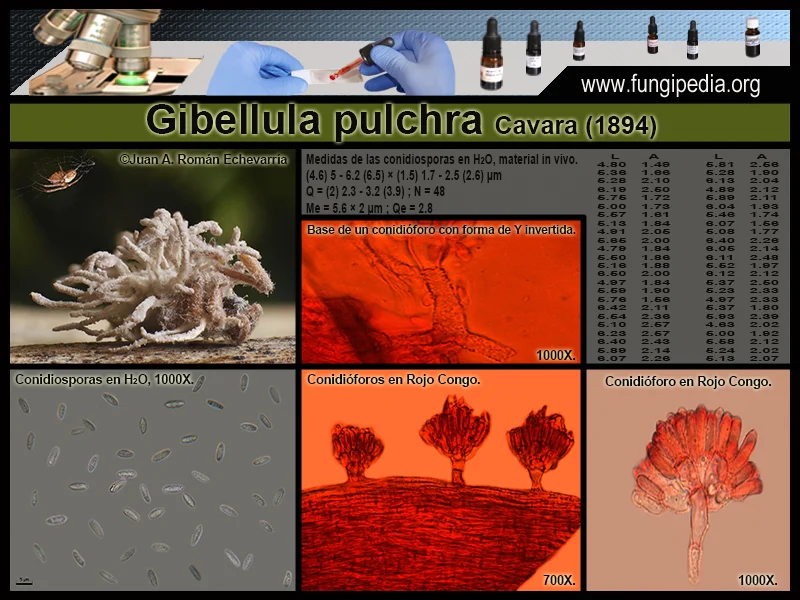
Carpophore formed from an enveloping mycelium, which can sometimes completely cover the host upon which it parasitizes. It does not always exhibit a uniform color; it may be yellow, or as in our collection, whitish to cream-colored. It typically has a velvety appearance, resembling fine down. The hyphae comprising it are hyaline, somewhat curled or undulate, and septate. They usually form and grow vertically, ultimately developing into reproductive structures known as synnemata.
Synnemata are erect, stalk-like structures that in our collection reach up to 11 mm in length, despite the parasitized spider measuring only about 3 mm. They typically exhibit a violaceous coloration when young, particularly towards the apex, later turning more cream-colored with brownish tones or retaining some violet hues. They are generally cylindrical, although they commonly thicken slightly towards the apex.
Conidiophores are formed through the interweaving and right-angled branching of hyphae, initially creating an inverted Y-shaped base that supports the structure. They produce specialized cells at the upper portion called phialides, which in the species under study typically cluster in fascicles. These phialides produce conidia abundantly and facilitate their dispersal.
Conidia are ellipsoid-fusiform and may be dispersed individually or occasionally in linear chains, resembling beads on a necklace. In our collection, they average 5–6 μm in length by 2 μm in width. All these features can be observed in our microscopy section.
Habitat:
This is a parasitic species that exclusively affects multiple arachnid species. In our case, it infected a small spider measuring only about 3 mm, whose body was completely enveloped by the fungal mycelium, rendering host identification impossible. Upon contact with the spider, the conidia of this fungus secrete enzymes that dissolve the exoskeleton, allowing them to penetrate the body cavity. However, they keep the spider alive and manipulate its nervous system, compelling it to climb to an elevated position where it is ultimately killed while clinging to leaves. This behavioral manipulation facilitates optimal dispersal of the conidia.
Observations:
This study corresponds to the conidial phase of the fungus. Under current nomenclatural standards, which adhere to a one-fungus-one-name system, it has been consolidated under the name Gibellula pulchra. Previously, its sexual state was designated as Torrubiella arachnophila var pulchra. Although it belongs to the family Cordycipitaceae, like Cordyceps, it exhibits distinct differences: the latter typically parasitize pupae and caterpillars, whereas the genus under study infects adult individuals. It may be confused with Gibellula leiopus; however, the latter possesses significantly smaller and simpler conidiophores.
Microscopy of Gibellula pulchra