
Gautieria morchelliformis
Taxonomy
Main synonym
Common names
Gautieria con forma de morchella
Geographic references:
Interactive map with data from GBIF.



Morphological Features:
Basidiocarp with the tuberculate or potato-like shape typical of this type of species, but in this case quite irregular, more or less oblong to globose with various protuberances. Its size is similar to that of other related species within the genus Gautieria; its diameter can range from 2 to 5 cm, and occasionally, somewhat larger specimens may be found. When buried and still retaining some peridium, it usually has a whitish or cream color, but it is normal and more common to find specimens lacking the peridium, in which case its color is distinctly ochraceous. The base usually bears mycelial remnants, and as occurs with all Gautieria species, it lacks a basal cavity.
Peridium or pseudoperidium, formed by interwoven hyphae with thin walls and lacking clamp connections, is very difficult to observe as it is absolutely evanescent; when the fungus emerges above ground, it completely lacks it, and what is observed is the gleba. If fortunate enough to observe it, it is whitish or cream-colored.
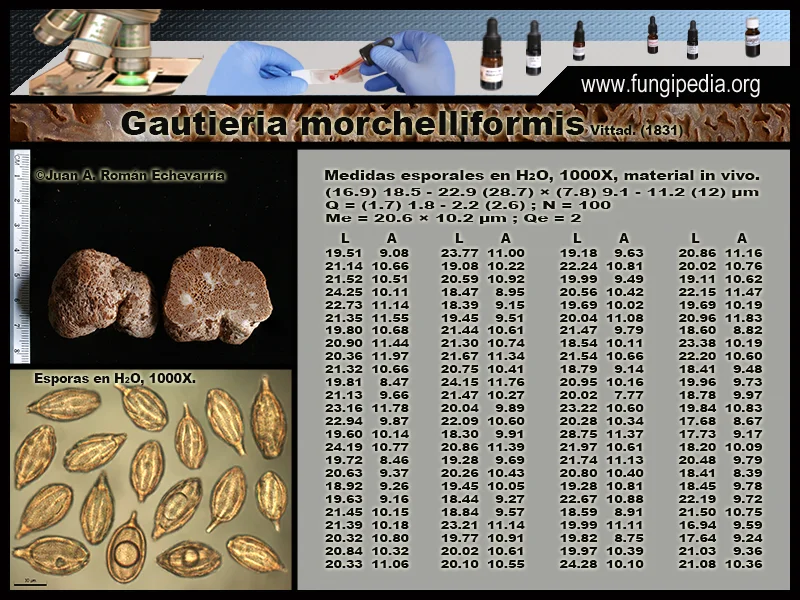
Gleba entirely labyrinthine in appearance, quite fleshy, composed of multiple cavities, initially light ochre in color, but with maturation adopting much darker tones and somewhat ferruginous hues. In cross-section, the columella can be observed, which is whitish or cream-colored. It produces yellowish-brown spores under the microscope, ornamented with longitudinal ridges that may fuse together, and which can exceed 20 μm in length.
Flesh nonexistent beyond the gleba itself; it has a rather strong, difficult-to-define odor in mature specimens, with some alliaceous undertones. When young, it barely smells, and its taste is sweet; despite this, it has no culinary value.
Habitat:
This is a species that should be considered semi-hypogeous, as it emerges at shallow depth and typically quickly protrudes above ground as it matures. It is an uncommon species in our region, typically fruiting while forming mycorrhizae with trees of the genus Quercus, such as the holm oak (Quercus ilex), or certain oaks like Quercus faginea. Although it may appear at other times of the year if conditions are favorable, it generally fruits during autumn. The collection used to compile this profile was made in November 2021 in Burgos.
Observations:
A genus comprising few species, most of which already have profiles on our website. This species is characterized by the near-complete absence of a peridial wrapper from an early stage, with the gleba being directly visible. In fact, species of this genus do not possess a true peridium like other hypogeous genera, but rather an enveloping structure formed by interwoven hymenial hyphae. It may be confused with other congeners; spore size and ornamentation must be examined to differentiate them. Gautieria graveolens has somewhat smaller spores with less pronounced ridges, Gautieria otthii exhibits an ornamentation of straight parallel ridges, whereas Gautieria trabutii is more easily distinguished by the warts on its ridges.
Microscopy of Gautieria morchelliformis