
Dumontinia tuberosa
Taxonomy
Main synonym
Common names
Copa de la Anemona
Geographic references:
Interactive map with data from GBIF.




Morphological Features:
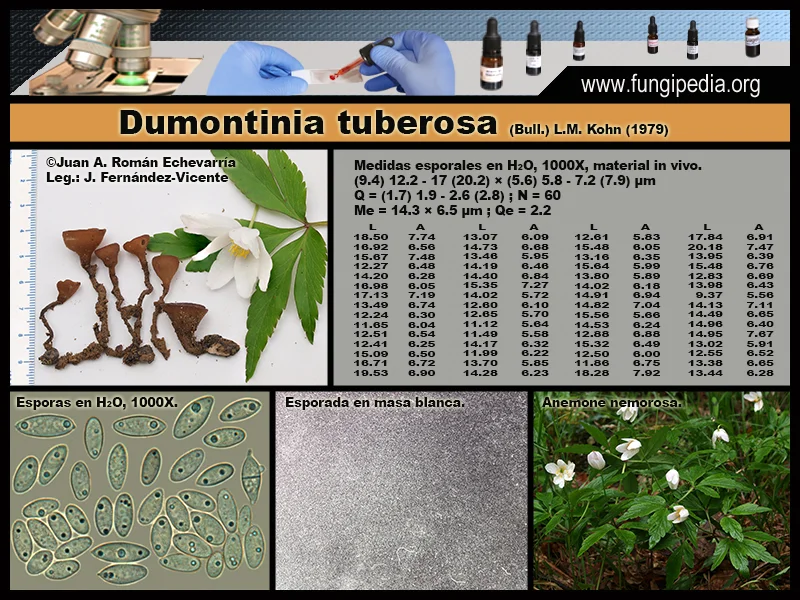
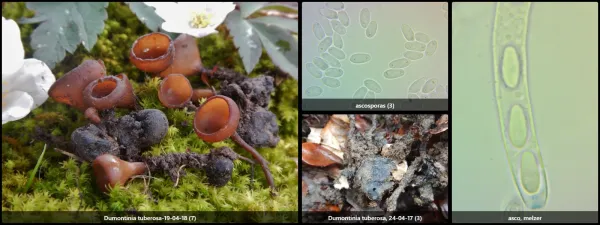
Fruitbody with a shape similar to species of the genera Ciboria, Ciborinia or Sclerotinia, featuring an upper cup-shaped zone that is quite closed when young, though it gradually opens with maturity until becoming nearly flattened, but with the margin always raised upwards. This cup is supported by a distinct stipe, typically reaching a diameter of at most 3 cm, with 1 to 3 cm being usual. Its external or excipular zone is brown, slightly lighter than the internal zone, apparently smooth to the naked eye, and somewhat pruinescent when viewed with a hand lens. The margin, in addition to being raised, is smooth; it does not usually show strong striations nor does it become crenulate.
Hymenium smooth, lining the inner surface of the cup, brown and slightly darker than the exciple. It produces amyloid, eight-spored asci with croziers, and ellipsoidal ascospores bearing two gutules at the poles, yielding a white spore print in mass; all of which can be observed in our microscopy section.
Stipe disproportionately elongated in some cases, reaching up to 7 cm in length in this collection. Its length varies depending on how deeply it is embedded in the substrate, and it is irregularly curved at times (flexuose). It is brown in the upper zone, but darkens towards the base to blackish tones. It arises from a consistently present black sclerotium, which is oval or irregular in shape with a quite hard texture, and appears white internally when cut.
Flesh very scant and poorly developed, somewhat firm in the stipe and slightly more elastic in the upper cup, with no notable odor or flavor to report.
Habitat:
This is a predominantly spring species with a rather exclusive habitat; it emerges from March onwards on the rhizomes of the plant Anemona nemorosa, initially forming a black sclerotium from which the fruitbodies develop. Given this exclusivity, it can be classified as an uncommon species in our region, although where it fruits, it typically does so in more or less numerous groups. The specimens studied here were kindly provided by Javier Fernandez Vicente and were collected in April in the town of Urkabustaiz (Álava).
Observations:
This is a species unique within its genus; Dumontinia is a monotypic genus. Macroscopically, it shares many similarities with other genera such as Ciboria, which does not specifically develop through a conspicuous sclerotium, and which does not affect the rhizomes of any plant species underground, but rather affects catkins or fallen fruits of various trees, and lacks lethal parasitic species. Sclerotinia is a similar genus that primarily affects many human crops; it also forms sclerotia, but evidently affects the aerial parts of plants.
Microscopy of Dumontinia tuberosa