
Hymenogaster citrinus
Taxonomy
Main synonym
Common names
Falsa trufa citrina.
Geographic references:
Interactive map with data from GBIF.





Morphological Features:
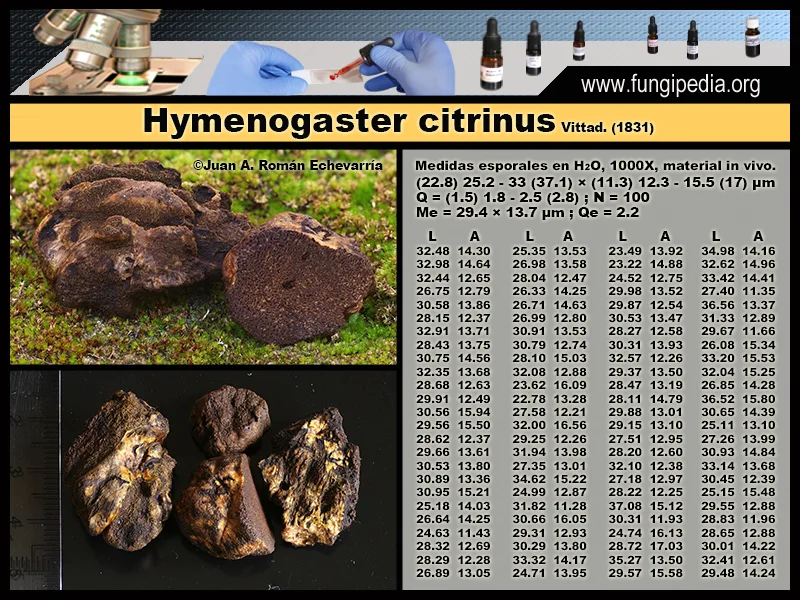
Fruit body rather small in size, the diameter of specimens in our collection ranging between 1 and 3 cm, with the typical tuberculate or small potato shape of hypogeous fungi, with some specimens practically spherical and others adopting more irregular or even turbinate shapes. In its early stage it has a whitish colour, turning yellowish or greenish-yellow upon maturing, but once unearthed, through oxidation, it tends to stain reddish-brown or blackish.
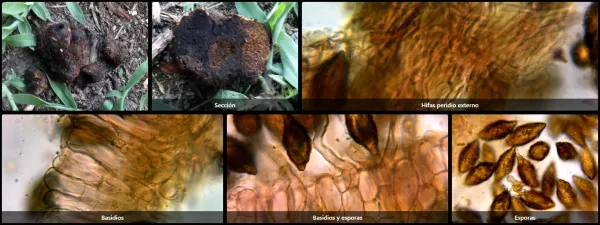
Peridium very thin, barely 2 or 3 mm thick, inseparable from the gleba, citrine yellow with a tendency to stain as mentioned above, possessing two distinct structures under the microscope (not to the naked eye): an outer prosenchymatous layer of intertwined hyphae, and an inner pseudoparenchymatous layer with more or less globose or polygonal hyphae, as can be seen in our microscopy.
Gleba labyrinthine, formed by tight venations visible to the naked eye, whitish in early stages, gradually darkening to brown tones with some paler veins; it does not become powdery with age as occurs in other hypogeous genera. It produces predominantly bisporic basidia and citriform, verrucose spores with a perispore.
Flesh consisting of the gleba itself, with a rather pronounced and characteristic somewhat sweetish odour that we did not find unpleasant at all.
Habitat:
Among the species of its genus it is probably one of the most common and prolific; it is easy to find several specimens in the same area using trained dogs, given that it is a subterranean (hypogeous) species. Furthermore, it can appear at any time of year if conditions are suitable for fruiting, and it is fairly cosmopolitan, lacking predilection for a specific tree and occurring under both broadleaf trees and conifers, though preferring basic soils. Our collections are under Quercus ilex, both in the province of Bizkaia and in Burgos.
Observations:
A species characterized by its small size, hypogeous growth, citrine peridium that discolours, bisporic basidia, and citriform verrucose spores with a perispore. Hymenogaster luteus is very similar macroscopically, but its spores lack a perispore and are smoother and less elongated; Hymenogaster bulliardii also has smooth spores. It can also be confused macroscopically with other genera, such as Rhizopogon luteolus, whose spores are very different, being ellipsoidal and hyaline.
Microscopy of Hymenogaster citrinus