
Geoglossum fallax
Taxonomy
Main synonym
Common names
Lengua de tierra engañosa.
Geographic references:
Interactive map with data from GBIF.



Morphological Features:
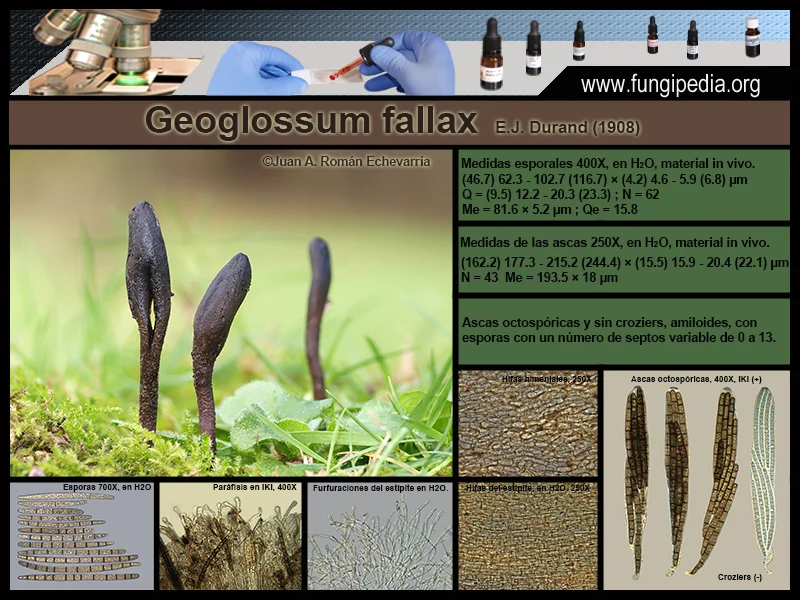
Fruit body similar in shape to all species of the so-called "earth tongues", developing fruiting bodies composed of a head in the upper part supported by a generally elongated stipe, without a clear demarcation normally visible between the two parts. The entire fruiting body reaches a length between 3 and 7 cm; the head occupies at least the upper third, is usually laterally compressed, in most specimens with a central furrow, and almost blackish in colour.
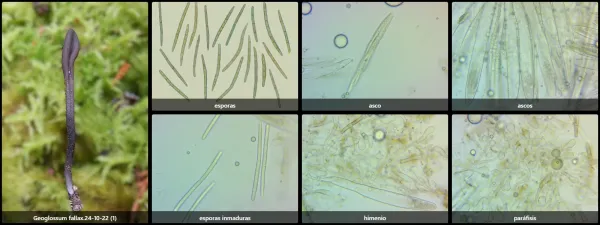
Hymenium smooth, occupying only the head (the fertile part of the ascocarp), blackish with an occasional olive tinge, producing eight-spored, amyloid asci without croziers, as well as multiseptate ascospores (with 0 to 13 septa in our collection); its paraphyses project above the asci and are usually filiform, but with a thickened apex and sometimes curved.
Stipe elongated and cylindrical, 2 to 4 mm thick, sometimes straight, but in most specimens curved or even flexuous; it is neither as smooth as the head nor hirsute, rather somewhat granulose or furfuraceous.
Flesh of elastic though somewhat tough consistency, slightly paler than the outer surface, without any noteworthy odour or taste.
Habitat:
This is a late-fruiting species, typically fruiting in late autumn and also in winter, tolerating cold conditions quite well. It is not overly common in our region, but where it occurs several specimens are usually found; like its congeners, it is a saprobic species favouring acidic soils in meadows or mossy slopes. The specimens used for this description were found in the Biscayan municipality of Galdakao in January.
Observations:
Species of the genus Geoglossum are difficult to classify and remain under continuous study, requiring extensive microscopic examination and even genetic sequencing to determine their specific identity with certainty. It often shares its habitat with Trichoglossum hirsutum, a common species in our region that possesses setae (hairs) on the stipe lacking in the species described here; other Geoglossum species such as Geoglossum cookeanum or Geoglossum umbratile tend to have a more fixed number of septa in their spores, without the high variability seen in Geoglossum fallax.
Microscopy of Geoglossum fallax