
Genea verrucosa
Taxonomy
Main synonym
Common names
Genea verrugosa
Geographic references:
Interactive map with data from GBIF.



Morphological Features:
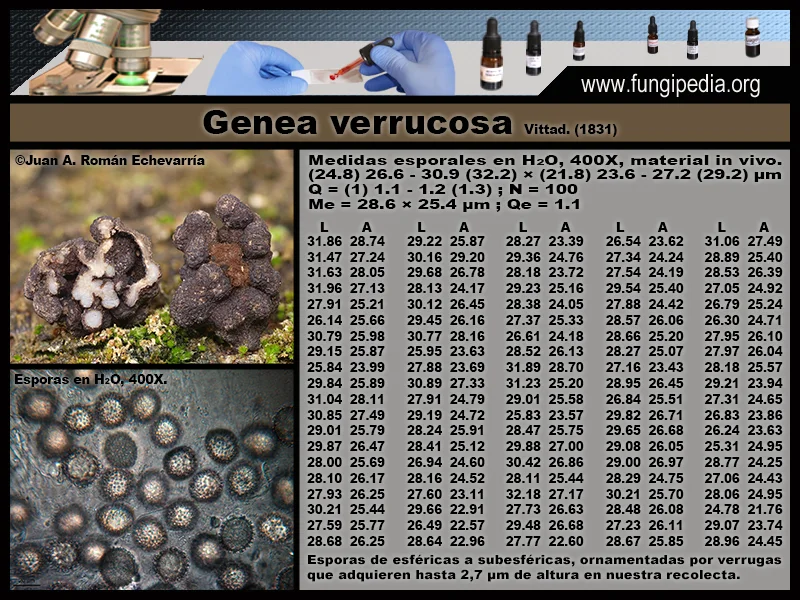
Fruit body with the typical shape of the vast majority of hypogeous species, resembling a small tuber, in this case very irregularly shaped, formed by a multitude of small lobes that give it a strange, wrinkled appearance. It is quite small in size, with adult specimens ranging between 1 and 2.5 cm in diameter, sometimes barely larger than a chickpea, and usually of a very dark, practically blackish colour. The presence of a brown mycelial cord at the base is typical.
Peridium dark brown to black, completely covered with small warts, sometimes barely noticeable to the naked eye but easily visible under a hand lens, which gives the species its name; these are usually somewhat flattened, not very prominent. Pseudoparenchymatous exoperidium formed by angular cells, and prosenchymatous endoperidium formed by intertwined filamentous hyphae; there is usually a zone where both structures somewhat intermingle.
Gleba completely hollow and labyrinthine, greyish when cut, formed by one or multiple cavities that give it a cerebriform appearance. It produces eight-spored, inamyloid asci, hyaline septate paraphyses, and verrucose ellipsoidal ascospores; see our microscopy section.
Flesh of hard and somewhat elastic consistency rendering it inedible; it has an aromatic odour when young, which becomes quite unpleasant with maturity, and we were unable to taste it since, given its hardness, it is impossible to chew.
Habitat:
This is a hypogeous species that tends to fruit at shallow depths, mycorrhizal with numerous tree and shrub species; in the south of the Iberian Peninsula it commonly mycorrhizes with various Cistaceae species (rockroses), whereas in our area of study it is more common under Quercus. It can appear at almost any time of year and has no predilection for a specific soil pH; the two collections used for this description were made in the province of Álava, in both cases under Quercus ilex.
Observations:
This species is characterized by its blackish, multilobed peridium with small warts, its hollow, labyrinthine greyish gleba, and its ellipsoidal, also verrucose spores. Recent phylogenetic studies suggest it does not represent a single lineage but a species complex; it may resemble several congeners such as Genea papillosa, which is reddish-brown, Genea fragrans, less lobed and with larger spores, or Genea clausa, although in the latter case the spores are smooth.
Microscopy of Genea verrucosa