
Pseudoboubovia benkertii
Taxonomy
Main synonym
Common names
Not available
Geographic references:
Interactive map with data from GBIF.



Morphological Features:
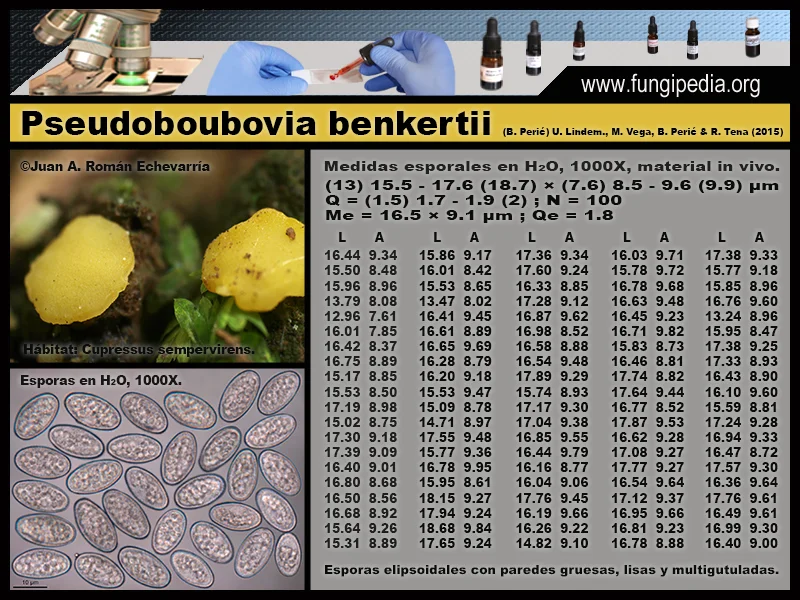
Apothecia minute in size; some references cite the possibility of specimens up to 8 mm in diameter, but adhering to the collection studied here, they did not exceed 3 mm. Predominantly yellowish, sometimes slightly orange (the difference between both colours may simply be incidental lighting), occasionally fading to paler whitish tones in specimens not directly exposed to sunlight. Pulvinate in early developmental stages, eventually becoming discoid or cushion-shaped, with a margin that is usually quite irregular. Yellow excipulum of globulose texture, the ectal excipulum composed of more or less globose cells of varying sizes.
Hymenium smooth, concolorous with the excipulum, shiny in high humidity conditions; microscopically notable for its aporhynchous asci at their base, eight-spored and uniseriate, non-amyloid, its thick-walled, hyaline ellipsoidal ascospores, and its cylindrical septate paraphyses containing yellow vacuoles, with an enlarged apex curved or straight at random.
Stipe absent; this is a sessile species attached directly to the substrate.
Flesh insignificant, inodorous and tasteless.
Habitat:
A species that typically grows gregariously (an isolated specimen is rarely seen), with a rather specialized habitat; although recorded under Pinus halepensis, it generally has a close affinity for trees of the genus Cupressus (cypresses), where it appears on litter, needles, or cones, and sometimes on moss or bare ground. A late-appearing species in late autumn and winter. The collection used for this record comes from the Basque Country, Leg.: M. Oyarzabal, J.F. Vicente, J. Arnedo, R. Ibarretxe.
Observations:
This is a monophyletic species, unique in its genus, originally described as Kotlabaea benkertii; phylogenetic studies demonstrated its proximity to the genus Boubovia, leading to its transfer to Pseudoboubovia. Its habitat may suggest its identity, but macroscopically it is impossible to distinguish from other species of Kotlabaea such as Kotlabaea deformis (distinguishable microscopically by spore shape and vacuolar content, among other subtle differences); it also resembles species of Pulvinula or Boubovia, the former having globose ascospores and the latter finely ornamented ones.
Microscopy of Pseudoboubovia benkertii