
Agrocybe putaminum
Taxonomy
Main synonym
Common names
Agrocibe del mantillo
Geographic references:
Interactive map with data from GBIF.




Morphological Features:
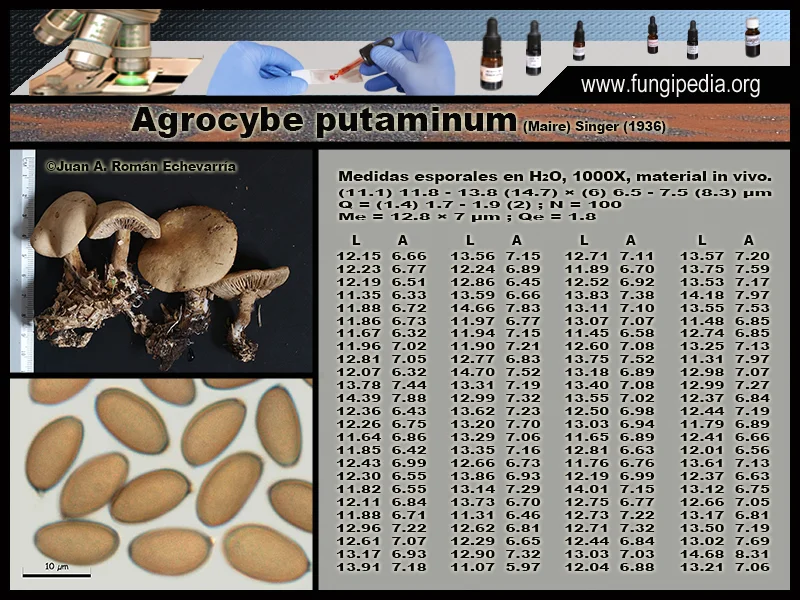
Pileus initially conical in early developmental stages, evolving to convex, and finally tending to flatten, albeit somewhat irregularly; some specimens even upturn slightly without ever becoming infundibuliform. The central area may develop an obtuse umbo, never acute, a somewhat variable character. Medium-sized; collected specimens measured 3–6 cm in diameter, occasionally slightly larger. Cuticle smooth and dry-looking, entirely lacking viscosity, matte, varying in color from dark cream to various shades of ochre, sometimes with a yellowish tint upon drying. Margin incurved, not involute, to straight, typically lacking striations.
Lamellae adnate or sometimes decurrent by a tooth, relatively crowded with numerous lamellulae, slightly less crowded in mature specimens. Initially pale cream-colored, turning brown upon sporulation. Spores are oblong to ellipsoid. Abundant cheilocystidia of various shapes occur on the lamellar edge; see our microscopy section.
Stipe cylindrical, with a length proportional to the pileus size. Typically slightly broader at the apex than in the middle, and usually exhibits basal thickening. The base often bears whitish rhizomorphs, abundant in some specimens. Color is quite pale, generally cream, though it tends to stain ochre upon handling. It also displays evident fibrils running along its entire length.
Flesh scant and somewhat insubstantial, whitish in color. Odor is faint; the scent of the substrate predominates over that of the fungus itself. Taste is sweet with a farinaceous undertone; it did not taste bitter upon testing, though it was not particularly pleasant.
Habitat:
This is a gregariously growing species, typically fruiting in clusters where it occurs; isolated specimens are rare, although it is not an overly common species. It usually fruits in ruderal areas and public gardens, on woody debris commonly used as substrate, and can do so practically year-round if environmental conditions are favorable. The specimens used for this description were kindly provided by Javier Fernandez Vicente and collected in Trapagaran, Bizkaia, in the aforementioned habitat.
Observations:
This species is characterized by its growth on garden mulch, a somewhat robust stature for the genus, a dry-looking pileus, and a notably fibrillose stipe that is thickened at the base. The spring species Agrocybe praecox also commonly fruits in gardens but is readily distinguished by the presence of a conspicuous ring, which is absent in the species described here. The most likely source of confusion may be Pholiota spumosa, which can also occur on garden substrates and shares a similar coloration; however, it differs in having a more viscid pileus and lamellae with yellowish tones prior to sporulation.
Microscopy of Agrocybe putaminum