
Geoglossum cookeanum
Taxonomy
Main synonym
Common names
Lengua de tierra de Cooke.
Geographic references:
Interactive map with data from GBIF.



Morphological Features:
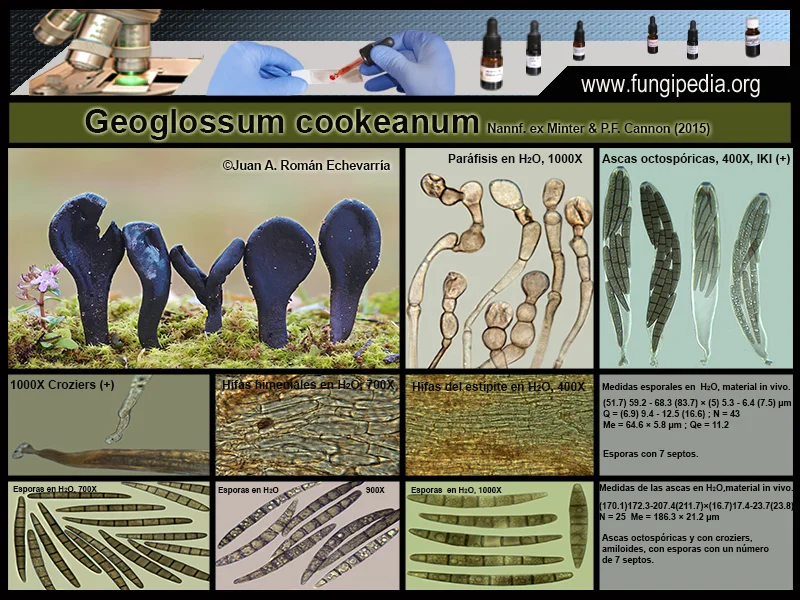
Fruit body with the typical shape of the so-called "earth tongues"; in the upper part arises a head that constitutes the fertile part of the fruit body, which can occupy at least one third of its total length, supported by a stipe, two distinct parts united together as a single whole. Total length in our collection ranged between 4 and 8 cm, and the colour is predominantly blackish, although some young specimens may display a brief metallic bluish tinge. The head may be grooved in the central zone, although this is an inconsistent character, and the apex is usually rounded. Surface smooth, non-viscid, occasionally quite pruinose but devoid of hairs.
Hymenium smooth, occupying the exterior of the upper head, which upon sporulating confers a pruinose appearance to it; it produces 7-septate ascospores, eight-spored and amyloid asci with croziers, and doliiform paraphyses, with chained cells of diverse shapes, very characteristic of the species, all perfectly discernible in our microscopy section.
Stipe cylindrical and elongated, presenting as an extension of the upper zone without a defined dividing line. It is concolorous with the upper part (what is observed in our photographs are sand grains from the substrate), smooth, and its surface is likewise non-viscid.
Flesh of the same colour as the outer surface, somewhat tough and elastic, completely insipid and inodorous.
Habitat:
This is a saprobic species that tends to fruit preferably in grassy areas or with bryophytes, with a strong predilection for coastal areas near the sea, even occurring on fixed sand dunes. In this habitat it is a relatively frequent species, usually appearing in groups (very numerous in our collection, which was made during a joint foray in Gorliz, Bizkaia, where we usually see it in late autumn and even in winter, being a late-fruiting species).
Observations:
Separating the species of these genera—colloquially termed "earth tongues"—is certainly challenging, requiring exhaustive microscopic analysis and, in most cases, phylogenetic sequencing; Geoglossum, Trichoglossum, and Microglossum are genera under continuous study, with new species being described in recent times. Geoglossum glabrum is a very similar species, to the point that both were once considered synonymous by some authors; they are distinguished by the paraphyses, which in that case are moniliform, and by the size of the asci, shorter in Geoglossum cookeanum. Other species with 7-septate spores exist, such as Geoglossum umbratile, which also bears some resemblance, although it possesses club-shaped paraphyses.
Microscopy of Geoglossum cookeanum