
Calocybe gambosa
Taxonomy
Main synonym
Common names
Seta de San Jorge, perretxiko, seta de Orduña, moixernó.
Geographic references:
Interactive map with data from GBIF.





Morphological Features:
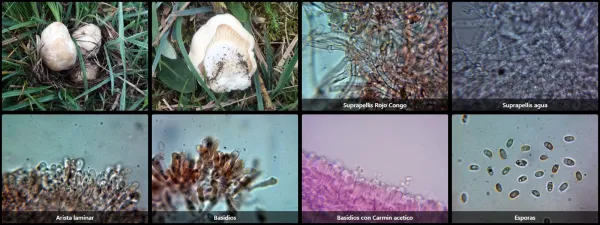
Pileus may exceed 10 cm in diameter; when young, the margin is incurved, later becoming convex and finally flat, with a matte whitish-cream coloration. It is very fleshy.
Lamellae white when young, becoming somewhat cream-colored at maturity; quite numerous and crowded, adnate to slightly sinuate.
Stipe whitish, sometimes short, central and cylindrical, though often thickened at the base; solid and pruinose.
Flesh firm and compact, white, with a strong and characteristic farinaceous odor. Its taste is also markedly floury, making it highly palatable.
Habitat:
This species fruits exclusively in spring. It is found in mountain meadows, alongside heather, blackthorn, or wild roses, but also occurs in coastal areas, on grassy slopes, orchards, and gardens. It is quite common, particularly in northern Iberia.
Observations:
It is a choice edible that commands high market prices, partly due to its short fruiting season and scarcity in many regions; however, we consider it somewhat overrated. It may be confused with Tricholomella constricta, which fruits in autumn on nitrogen-rich soils. It can also be mistaken for Entoloma sinuatum, another autumnal species with a less farinaceous odor, which is highly toxic.