
Otidea tuomikoskii
Taxonomy
Main synonym
Common names
Oreja de liebre de las piceas
Geographic references:
Interactive map with data from GBIF.





Morphological Features:
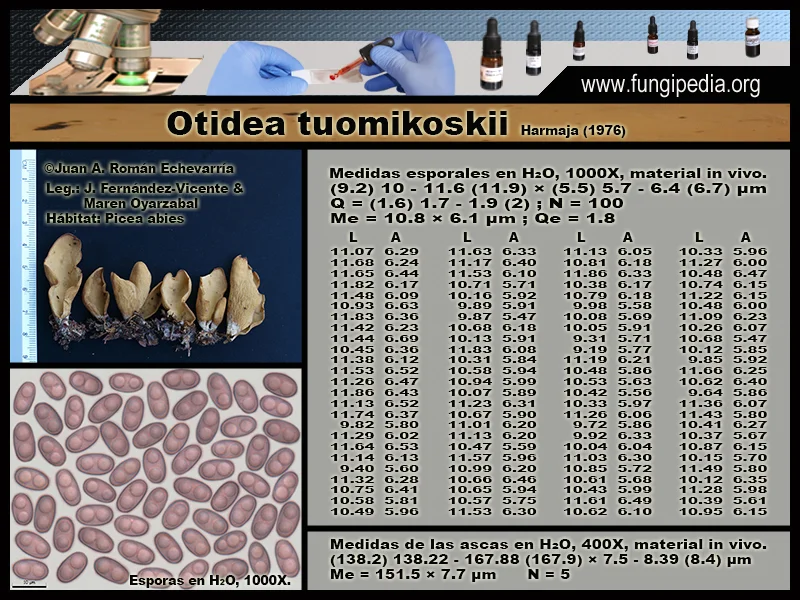
Fruiting body with a curious shape strongly reminiscent of folded hare ears. This species forms apothecia reaching or slightly exceeding 5 cm in height, typically 2 to 4 cm, with a distinctly pointed apex. In young specimens, two lateral lobes may approach each other, separated by a cleft extending from the apex to the stipe; over time, they tend to separate further or adopt more irregular shapes. The external zone, or exipulum, is ochre with notable yellowish or orange hues depending on maturity, and exhibits longitudinal rugae containing faint, slightly darker minute verrucae.
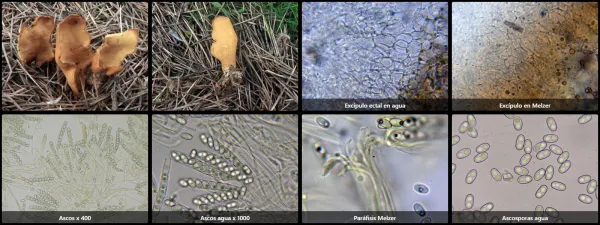
Hymenium lining the internal surface of the apothecium, completely smooth and lacking the rugae characteristic of the external zone. It is yellow with varying intensity among specimens, sometimes exhibiting dull tones. It produces ellipsoidal, smooth, and hyaline spores, eight-spored asci, and paraphyses with a curved, sickle-shaped apex; all these features are observable in our microscopic section.
Stipe very short, barely noticeable in many cases as it is embedded in the substrate. It is concolorous with the exipulum and, in some instances, bears abundant whitish mycelial remnants.
Flesh quite thin and somewhat insubstantial, with a slightly brittle texture. It possesses virtually no notable odor or taste.
Habitat:
This species exhibits a gregarious growth habit, typically appearing in more or less numerous clusters rather than solitarily. However, it must be considered rare and infrequent, largely due to its highly specific habitat requirements. It is recorded exclusively under spruces (Picea) and firs (Abies). In our region, it occurs solely in mature stands of Picea abies. It is precisely within this specific habitat that the specimens utilized for this profile were collected, courtesy of Javier Fernandez Vicente and Maren Oyarzabal, comprising collections from Álava and the province of Bizkaia.
Observations:
This species is characterized by its hare-ear shape, the dull coloration of its longitudinally furrowed and somewhat verrucose external zone, and its occurrence under conifers, particularly spruces (Picea). Several species within the genus may be confused with it. Otidea onotica is more cosmopolitan and possesses significantly larger spores. However, Otidea mirabilis does have similarly sized spores; its exipulum exhibits purplish tones, especially when young, which are absent in the species described here. Additionally, Otidea leporina, which shares a similar shape and spore size, may also be confused with it; notably, this species does not react with an intense yellow coloration to KOH, unlike Otidea tuomikoskii.
Microscopy of Otidea tuomikoskii