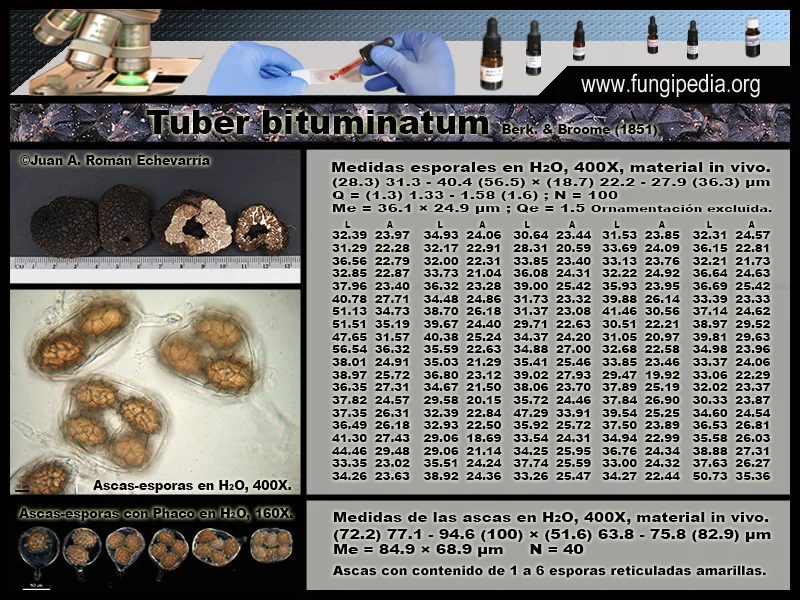

Tuber bituminatum
Taxonomy
Main synonym
Common names
Trufa bituminosa
Geographic references:
Interactive map with data from GBIF.

Morphological Features:
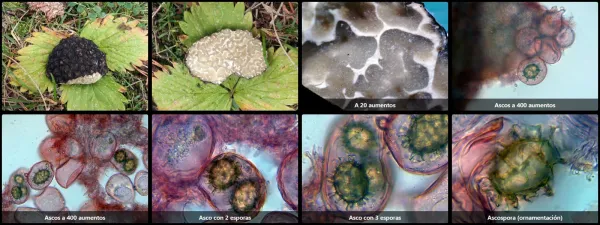
Fruit body adopting a practically spherical shape in young, immature specimens, but once developed can become more oblong or irregular, although it is not characterized by excessive bumps. All collected specimens present an evident and wide basal cavity, which can sometimes span the entire radius of the ascoma. It is dark brown or blackish in color, and rather small in size, generally 2 to 4 cm in diameter, occasionally reaching 6 cm. Its overall appearance is quite compact, fleshy, and warty.
Peridium very dark brown or practically black, formed entirely of very prominent, sharply defined pyramidal warts with 4 to 6 facets, each measuring about 4 to 7 mm at its base, occasionally somewhat flattened but mostly pointed, notably featuring longitudinal striations that give it a somewhat rugose appearance. It is a fairly compact peridium that is very difficult to separate from the gleba, rarely coming off when brushing off dirt.
Gleba compact and solid, filled, without internal cavities, pale in immature specimens, but rapidly taking on a more or less dark brown color in its fertile part, while retaining sterile veins of a much paler color that usually do not change with maturity.
Flesh which is none other than the gleba itself, fairly compact and hard, with an odor that is not as pronounced in immature specimens as in related species, but becomes very strong with maturity, reminiscent of bitumen or tar, and rather unpleasant in our opinion; however, it does not possess an analogous flavor as might be expected, though it does not taste good enough to be considered a good edible either.
Habitat:
As with all species of the genus Tuber, this is a hypogeous species, though it usually does not grow at great depth and can break through the soil surface forming cracks; finding it is difficult without the help of specially trained dogs. It usually fruits from spring onwards, maturing in summer and autumn. It is reported to mycorrhize broadleaf trees such as beech (Fagus sylvatica), hazel (Corylus avellana), or various Quercus species. Our two collections used for this description were made in the province of Álava, Basque Country, mycorrhizing large-leaved lime (Tilia platyphyllos) in both cases, both collected in the month of June.
Observations:
This is a species that should be classified as uncommon, given the scarce information available on it, probably because it is difficult to differentiate from other members of its genus. Commonly confused with the excellent Tuber aestivum, with which it can share habitat and fruiting season, one must note that the latter lacks any basal cavity and has a very pleasant nutty aroma. Differentiating it from Tuber mesentericum is much more challenging, as they are practically identical both macroscopically and in organoleptic characteristics: the latter smells strongly of tar even when young, has slightly narrower spores, and exhibits a slight difference in the cellular arrangement of the warts.
Microscopy of Tuber bituminatum