
Genea sphaerica
Taxonomy
Main synonym
Common names
Genea esférica
Geographic references:
Interactive map with data from GBIF.



Morphological Features:
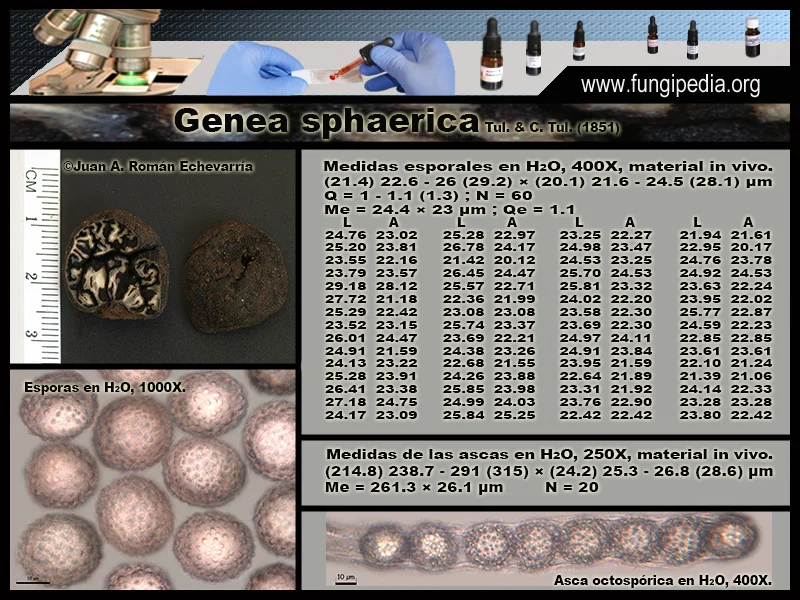
Carpophore with the typical small tuber-like morphology characteristic of this group of hypogeous species. In this case, its shape can be described as quite stable; within a single collection, many specimens are practically spherical and lack protuberances, although a few do exhibit lobes or bumps, albeit not particularly prominent. It is a small-sized species, with a diameter that may reach up to 3 cm at most. The surface is rough and glabrous, with a very dark, practically black coloration. Mature specimens typically display an apical opening resembling an ostiole, which aids in spore dispersal. The base lacks a cavity and may bear brown mycelial cords.
Peridium dark brown or, more typically, black, entirely covered by more or less pyramidal but very low-profile scales that impart a rather rough texture. Microscopically, it comprises two distinct layers: an outer layer composed of thick-walled, clearly pigmented hyphae with an angular texture, and a second, unpigmented layer formed by hyphae arranged in a globose texture that narrow as they approach the gleba. The first layer is twice as thick as the second; refer to our microscopy section for full details.
Gleba Unlike other genera of hypogeous species, the gleba is not compact but rather the opposite. Genea species exhibit labyrinthine glebas with a characteristic central cavity traversed by folds, which change color from whitish to brown upon maturation and may eventually form secondary cavities between them. Microscopically, they are characterized by eight-spored asci possessing an elongated pedicel-like structure, hyaline paraphyses that are typically longer than the asci, and warty spores whose ornamentation does not coalesce into crests.
Flesh Hard in texture, even somewhat cartilaginous. It lacks the pronounced aroma typical of truffles, being rather faint or absent. No species within this genus is considered edible.
Habitat:
This is a hypogeous species that grows underground at shallow depths. It is not particularly abundant but is widely documented within our survey area. It shows a preference for alkaline soils of calcareous origin, where it fruits throughout most of the year except in summer, forming mycorrhizal associations with tree species such as holm oak, oak, or beech. The collection that served as the basis for this profile originates from the province of Burgos, where it was located in November using trained dogs within a holm oak (Quercus ilex) forest.
Observations:
This species is characterized by its spherical shape, black coloration, peridium bearing low-profile warts that impart a rough texture, and, like all members of its genus, a hollow gleba traversed by a series of folds. Consequently, identifying a specimen as belonging to this genus is relatively straightforward; however, distinguishing between the different species within the genus is highly challenging, with perhaps the exception of Genea lespiaultii, which possesses elliptical spores that deviate from the general rule. Spore ornamentation is key for identification: this species features abundant, blunt-tipped warts, whereas other species exhibit pointed warts, such as Genea verrucosa.
Microscopy of Genea sphaerica