
Lentinellus micheneri
Taxonomy
Main synonym
Common names
Lentino de pinar
Geographic references:
Interactive map with data from GBIF.


Morphological Features:
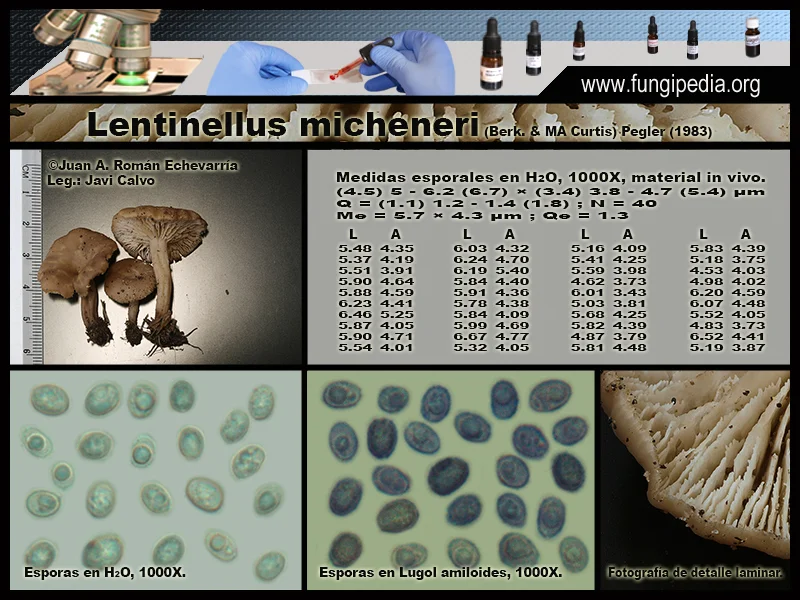
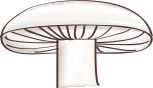
Pileus small in size; collected specimens had diameters ranging from 1.5 to 3 cm, reaching up to 4 cm at most. It has an omphaliform appearance, with young specimens being convex and featuring a deeply depressed center resembling an umbilicus; later it flattens considerably, and the margin may even become slightly raised while the central area remains more depressed. This margin is incurved when young, then becomes plane and somewhat undulate. The color is highly variable due to its strongly hygrophanous nature; wet specimens typically exhibit a darkish ocre-beige hue, but fade noticeably to straw-like tones upon drying.
Lamellae with variable attachment to the stipe, generally adnate or decurrent by a tooth, but occasionally in some specimens they may be more strongly decurrent. They are notably ventricose and broad, rather distant from one another, whitish or more commonly cream-colored. The lamellar edge is entire and deeply serrate throughout each lamella, a highly diagnostic feature of the genus that is particularly pronounced here.
Stipe rather short, reaching barely 2 cm at most. It is fairly uniformly brown except at the apex, which may be paler. Sometimes cylindrical and at other times somewhat compressed, occasionally grooved. Straight or frequently sinuous. Usually central but eccentric in some specimens, with a clear tendency to taper toward the base, which bears yellowish mycelial remnants.
Flesh tough and thin, rather elastic, somewhat firmer in the stipe than in the pileus. It absorbs considerable moisture, becoming watery in texture during rainy conditions. The odor is mild and unremarkable, while the taste is notably pungent.
Habitat:
This is a saprobic species that may fruit directly on wood or simply on woody debris lying on the ground. Its preferred fruiting period is autumn and early winter. It should be considered rare due to its highly localized distribution; however, where it occurs, it typically fruits in groups, either as scattered individuals or in clustered tufts on wood. Although reported to occur under broadleaf trees, we have consistently observed it beneath conifers. The specimens used for this description were collected in Gumiel de Izan (Burgos province), apparently fruiting from the ground in a sandy Pinus pinaster pine forest alongside Cistus laurifolius.
Observations:
This species is characterized by its small size, its morphology reminiscent of Omphalina species, its strongly serrate lamellae, and its mild odor combined with a pungent taste. Due to these features, it is relatively easy to identify macroscopically. Serrate lamellae are a common trait within the genus Lentinellus, also found in Lentinellus cochleatus; however, that species is larger, typically fruits on broadleaf wood, and possesses an intense, characteristic anise-like odor absent in Lentinellus micheneri. It is without culinary value due to the toughness and scantiness of its flesh, as well as its pungent taste.
Microscopy of Lentinellus micheneri