
Hysterangium inflatum
Taxonomy
Main synonym
Common names
Histerangio de esporas infladas
Geographic references:
Interactive map with data from GBIF.


Morphological Features:
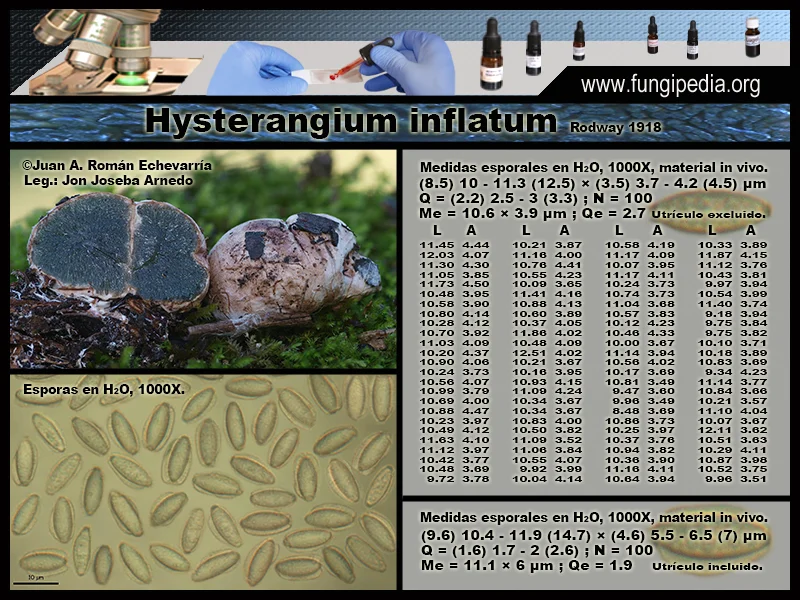
Basidiocarp characterized by its small size, slightly larger than a chickpea; the diameter of specimens of this species typically ranges from 0.5 to 2 cm, occasionally somewhat more. It usually has a globose or oblong shape, generally quite regular, and is not a species that typically exhibits large protrusions or deformities. Young specimens when subterranean or just emerging are usually whitish, but gradually develop brownish patches in areas, and additionally acquire a reddish tint upon handling. At the base, it bears abundant white rhizomorphs, which can form a veritable tangle and extend upwards, partially enveloping the basidiocarp.
Peridium smooth and glabrous outer covering, quite hard and difficult to separate from the gleba, initially practically white in color, developing brownish patches with maturation and pinkish or reddish tones upon handling. It consists of two differentiated layers: an exoperidium (outer layer), pseudoparenchymatous, with pigmented globose hyphae, and an endoperidium composed of elongated, non-pigmented hyaline hyphae.
Gleba hard and compact, composed of a succession of very small, tightly packed chambers, lighter green in young specimens, turning dark olive-green as it matures, and tending to liquefy once its reproductive function is complete. In the center, it features a prominent and broad columella that tends to branch radially. It produces characteristic spores with lateral widening, appearing wing-like; these "inflated" spores give the species its name.
Flesh which is nothing other than the gleba itself, slightly elastic in texture, not suitable for tasting, especially considering the strong, complex odor it emits, which is more pronounced in mature specimens.
Habitat:
This is a species with a clear Australian origin; it is therefore an introduced species that has reached our territory thanks to the numerous Eucalyptus plantations established in recent decades. It is exclusive to this habitat and typically fruits from late autumn to early spring, generally in groups of several specimens. Initially hypogeous, it gradually emerges to the surface as it matures, so it can be considered a semi-hypogeous species. The specimens used for this profile were collected alongside Jon Joseba Arnedo in the Biscayan locality of Gorliz under Eucalyptus globulus. In its exclusive habitat, it is a fairly common species.
Observations:
This species is characterized by its small size, green gleba composed of tightly packed chambers with a central columella, wing-like (inflated) spores, and its exclusive habitat under Eucalyptus spp. Species of this genus generally lack culinary interest and are inedible. It may be confused with other species such as Hysterangium clathroides, a species commonly found under Cistus, holm oak, oak, or chestnut, never under eucalyptus, and whose spores lack wings; due to shared habitat, it may also be confused with Reddellomyces donkii, but the gleba of the latter is white.
Microscopy of Hysterangium inflatum