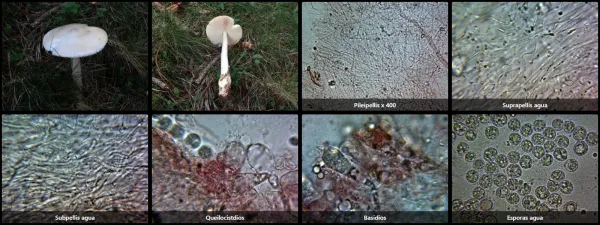
Amanita vaginata
Taxonomy
Main synonym
Common names
Cucumela, kukumela grisea, pentinella, amanita enfundada.
Geographic references:
Interactive map with data from GBIF.




Morphological Features:
Pileus with a diameter ranging from 5 to 10 (12) cm in adult individuals, bell-shaped during the initial growth phase, gradually expanding to become practically flat while retaining a small acute umbo at the center. The cuticle is widely striate and separable, with color varying according to variety; ash-gray in the type species, lead-gray or even white. Young specimens bear extensive remnants of the universal veil that tend to disappear easily, making it more common to find mature fruiting bodies without them.
Lamellae free from the stipe, relatively crowded, narrow, and with abundant lamellulae arranged somewhat irregularly. White in color, with the edge of the same hue and slightly silky.
Stipe disproportionately elongated relative to the pileus and easily separable from it. White in color, solid when young, later becoming fistulous or hollow. Scarcely ornamented, lacking a ring but featuring a membranous, sack-like volva at its equally white base.
Flesh white, thin, and of fragile consistency; it breaks with the slightest handling. It has barely any odor, and its raw taste is sweet and pleasant.
Habitat:
A cosmopolitan species with a wide distribution, it fruits equally well in practically any type of forest, both broadleaf and coniferous, including holm oaks, oaks, beeches, cork oaks, and pines. It is also a very common species throughout the Iberian Peninsula. It grows solitarily or in small groups, and can be observed almost year-round provided climatic conditions are suitable.
Observations:
An edible but thin-fleshed species requiring due caution, as it is toxic when raw. It contains hemolysins that destroy red blood cells; these substances are thermolabile and degrade at approximately 70 °C, so the mushroom must be thoroughly cooked. Historically, all *Amanitopsis* or ringless *Amanitas* were considered varieties of the type species *Amanita vaginata*; currently, many are recognized as distinct taxa. Aside from details such as pileus color (*Amanita fulva*) or characteristic depressions on it (*Amanita malleata*), they all share a certain resemblance. Caution should be exercised to avoid confusing it with the deadly poisonous *Amanita virosa*, especially regarding the white specimens of *vaginata*; the presence of a ring and the unpleasant viroid odor serve to prevent such confusion.