
Amanita rubescens
Taxonomy
Main synonym
Common names
Oronja vinosa, Galdacanesa, Amanita rojiza, Galdakao lanperna, ardotsu.
Geographic references:
Interactive map with data from GBIF.





Morphological Features:
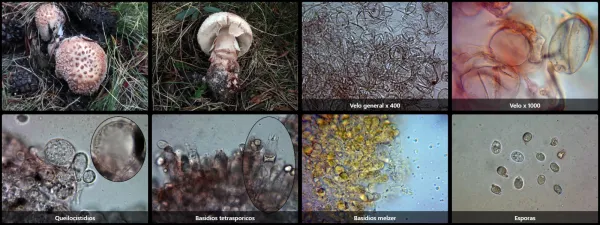
Pileus up to 15 cm in diameter, initially globose and very pale, later hemispherical and ochre, eventually convex or flattened with a more reddish hue. Cuticle covered with whitish-grey veil remnants, smooth, not striate.
Lamellae completely white when young, developing reddish tones in age as blotches. Free to at most adnate. Quite crowded.
Stipe pale or pinkish in color, developing wine-red tones from the base upwards, where it is easily wormed. Its length and shape are highly variable. Rather than a volva, it appears to have a bulb at the stipe base, and additionally bears a very striate, membranous, and persistent ring white to pink (yellow in variety annulosulphurea).
Flesh white, turning reddish at injuries and in wormed areas, with a mild fungal odor and a sweet taste that becomes slightly bitter upon prolonged mastication.
Habitat:
A common species appearing in spring as well as summer and autumn, found indiscriminately in deciduous or coniferous forests.
Observations:
A choice edible, yet toxic when raw due to the presence of a hemolysin capable of destroying red blood cells, a compound that volatilizes with proper cooking. It is commonly consumed in the Galdakao area (Biscay), where it holds an ancestral culinary tradition. It is often confused with the toxic Amanita pantherina, which never exhibits wine-red tones; however, the most similar species is Amanita franchetii, suspected to be toxic.