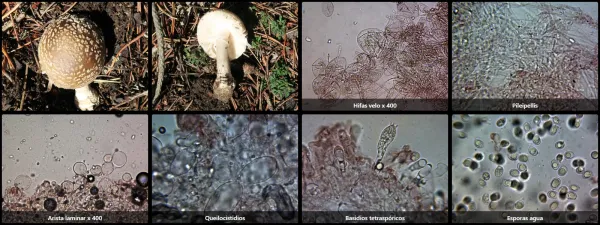

Amanita pantherina
Taxonomy
Main synonym
Common names
Amanita pantera, lanperna txar, pixacá.
Geographic references:
Interactive map with data from GBIF.



Morphological Features:
Pileus may exceed 10 cm in diameter, convex to flattened, greyish-brown with variable tonality. Its cuticle is covered with completely white, mealy-textured scales which are remnants of the volva from which the basidiocarp emerges; in rainy weather, these scales may disappear. In the type species, the pileus margin is distinctly striate.
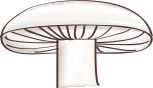
Lamellae very white, free from the stipe and rather crowded.
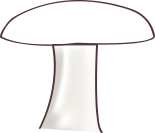
Stipe cylindrical and central, white, thickened at the base. It bears a white, pendent ring that is smooth or weakly striate. The volva is floccose and adnate to the stipe, extending upwards in the form of helical bands.
Flesh thin, white, with a radish-like odor albeit very faint, and a sweet, not unpleasant taste.
Habitat:
A frequent autumnal species that fruits equally in coniferous and broadleaf forests, particularly in forest clearings.
Observations:
A highly toxic species that, when consumed in large quantities, can cause severe poisoning; furthermore, it lacks a bitter taste, making it particularly dangerous. It is often confused with Amanita rubescens, which exhibits vinaceous tones upon bruising and has a smooth, non-striate pileus margin. The variety abietum exists, which is more fleshy and less striate, and is defined by a habitat in mountain fir and coniferous forests.