Verpa bohemica
Taxonomy
Main synonym
Common names
Falso morel.
Geographic references:
Interactive map with data from GBIF.





Morphological Features:
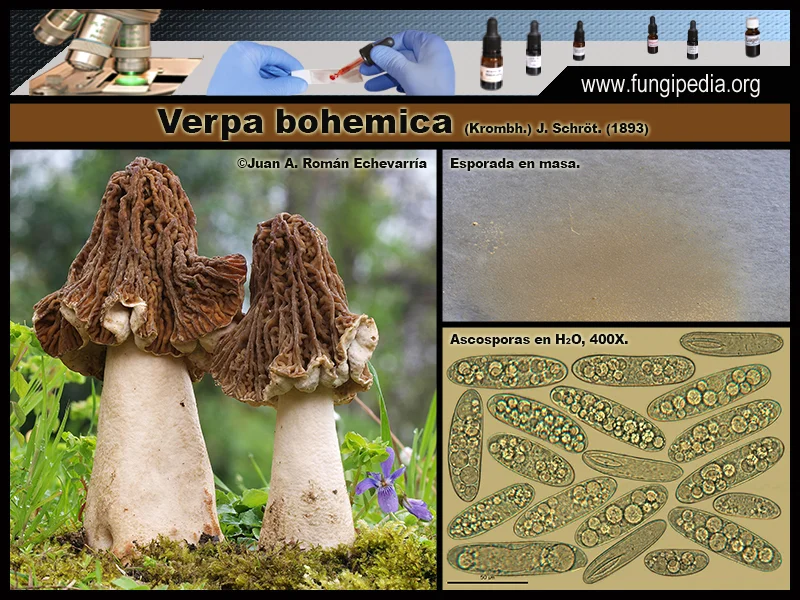
Pileus campanulate or thimble-shaped, 2–3 cm wide and up to 4 cm high, positioned at the apex of the fruitbody like a hood, attached to the stipe only by the upper disc. Its color is dark brown due to the presence of intersecting ridges that form a cellular pattern, similar to that observed in Morchella species.
Hymenium located on the inner surface of the pileus, as the external ridges are sterile. It is paler than the ridges and smooth.
Stipe very long, reaching up to 15 cm, whitish or cream-colored, occasionally acquiring yellowish tints. Typically cylindrical, though somewhat irregular and furfuraceous.
Flesh scant and thin, fragile, with no distinctive taste or odor.
Habitat:
This species fruits exclusively in spring, occurring beneath broadleaf trees and riparian woodland; it is uncommon to rare.
Observations:
Although edible after thorough cooking, we do not recommend harvesting or consuming this species for two reasons: firstly, it is not a choice edible, and secondly, it warrants protection due to its rarity. It resembles Verpa digitaliformis, which has a smooth or merely wrinkled pileus lacking ridges, as well as Mitrophora semilibera, in which the pileus is detached from the stipe only at the lower margin.
Microscopy of Verpa bohemica