
Morchella semilibera
Taxonomy
Main synonym
Common names
Crespiño, Sasikarraspina.
Geographic references:
Interactive map with data from GBIF.

Morphological Features:
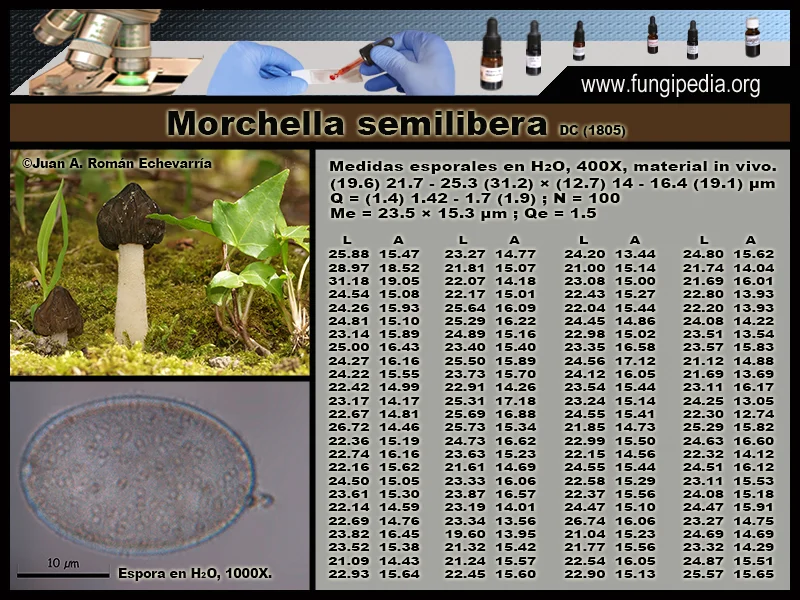
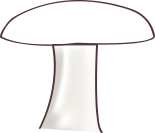
Pileus conical and hollow, small relative to the stipe size, matte grayish-brown in background color but with prominent longitudinal and transverse dark veins forming a type of alveoli, which are quite irregular. The lower portion is free from the stipe.
Hymenium located on one surface of the pileus, light olive-brown in color, becoming paler towards the base.
Stipe white and very long, occasionally reaching up to 20 cm, hollow and attached to the pileus at the apex, superficially exhibiting a "goose-bump-like" texture.
Flesh fragile in consistency, whitish and somewhat tenacious, with no remarkable features regarding odor or taste.
Habitat:
A spring species that occurs near riparian trees and favors moist, shady areas; it is frequently found associated with the plant Ficaria radunculoides.
Observations:
An edible species, though of inferior quality compared to Morels, it bears a certain resemblance to them; however, the lower portion of the pileus is not attached to the stipe, which serves as a distinguishing feature. Should this species be consumed, it must be thoroughly cooked beforehand.
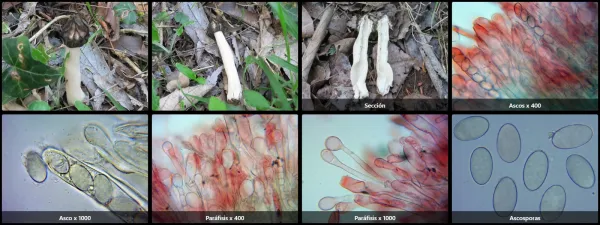
Microscopy of Morchella semilibera