
Tricholoma columbetta
Taxonomy
Main synonym
Common names
Palomita, ziza uso-zuri, llenega blanca, llenega dolc, tortullo blanco.
Geographic references:
Interactive map with data from GBIF.



Morphological Features:
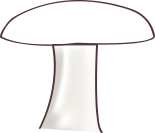
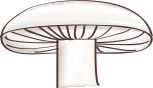
Pileus with a diameter ranging from 5 to 10 cm in adult specimens, initially convex-campanulate, then convex, and finally flattened, with an obtuse umbo that is sometimes not very well-defined. Glabrous cuticle pure white in young specimens, which may acquire an ochraceous tinge towards the center in more developed individuals; even in older specimens, greenish or reddish spots are not uncommon, heralding tissue necrosis. Glossy when wet and satiny when dry, easily separable from the flesh. Margin incurved in youth, later undulate.
Lamellae sinuate or sometimes unguiculate, broad and crowded, almost always white, becoming cream-colored in older specimens. Gill edge irregular, sometimes crenulate, concolorous or occasionally splashed with reddish spots.
Stipe cylindrical and elongated, solid and firm, frequently attenuate at the base, white like the rest of the basidiome. Surface fibrous and fibrillose, especially at the apex. Relatively frequently exhibits turquoise-blue or pinkish stains at the base, though this is a highly inconstant character.
Flesh not very thick but firm, more fibrous in the stipe than in the pileus. White and unchanging on exposure, except at the stipe base where it may occasionally acquire pinkish tints. Practically odorless with a slightly farinaceous taste.
Habitat:
Species fundamentally associated with broadleaf forests, typically appearing in beechwoods, oakwoods, and primarily under riparian trees. It is not a highly prolific species and could be described as uncommon, being even rarer under conifers. Besides being infrequent, it is by no means abundant, as it may grow solitarily or in small groups of a few specimens. Its preferred fruiting period is late summer and throughout autumn.
Observations:
This species is an edible mushroom with a pleasant appearance and good flavor, though perhaps excessively fibrous, particularly in the stipe. It is characterized by the white coloration common to the entire basidiome, the near absence of a characteristic odor, its slightly farinaceous taste, and the bluish stains at the stipe base which are not always present. Due to its coloration, it may be confused with deadly white Amanita species, but the absence of a ring and volva quickly rules out this possibility. It is much more difficult to distinguish it from other white Tricholoma species, such as Tricholoma album, which has a neutral odor in youth that becomes unpleasant with age and a bitter taste.
