
Amanita verna
Taxonomy
Main synonym
Common names
Cicuta blanca, hiltzaile goiztiar, cogomasa.
Geographic references:
Interactive map with data from GBIF.


Morphological Features:
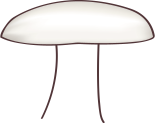
Pileus of intermediate size, with a diameter ranging from 5 to 10 cm. Initially globose or hemispherical, it becomes convex and finally flattens out, although this occurs only in its most advanced developmental stage, retaining its hemispherical shape for an extended period. It is white in color, though it may appear pale cream, particularly when mature. The cuticle is separable and thin, dry or shiny when wet, but not viscid. The margin is fairly regular and non-striate.
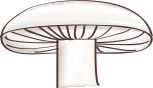
Lamellae free from the stipe, white, fairly dense and crowded, with interspersed lamellulae.
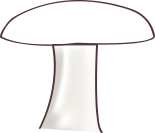
Stipe central and cylindrical, white and proportionate to the pileus, although it is sometimes deeply buried and appears more elongated. It is smooth or slightly adorned with concolorous squamules. It bears a white membranous ring in the upper third, and at the base a sack-like membranous volva of the same color. Solid when young, later becoming fistulose.
Flesh white, thin, with a faint odor and a mild, sweet taste.
Habitat:
Grows in spring in pine forests or deciduous woodlands, with a preference for acidic soils. It is an uncommon species in northern Iberia.
Observations:
Belonging to the deadly Amanita trio, a single specimen can kill a healthy person. The inexperienced amateur may confuse it with some common mushrooms, but these possess pinkish lamellae and lack a volva. Numerous poisoning cases are occurring due to confusion with Amanita ponderosa (gurumelo), a species with a more pronounced and typical odor whose flesh oxidizes. Since fruiting bodies sometimes appear out of season, we note its striking resemblance to the edible Leucoagaricus leucothites, which possesses a basal swelling but lacks a volva, and whose lamellae turn pink due to spore deposition upon maturation. Very similar is the autumnal species, also deadly poisonous, Amanita virosa.