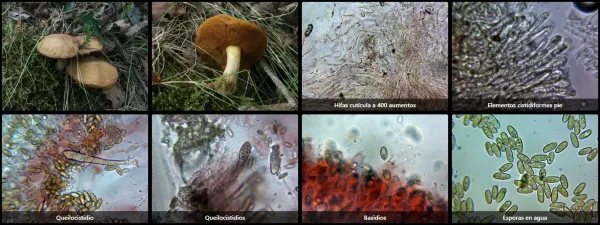

Suillus granulatus
Taxonomy
Main synonym
Common names
Boleto granulado, pinudi-onddo bikordun, molleric granellut.
Geographic references:
Interactive map with data from GBIF.


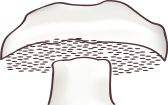
Morphological Features:
Pileus rarely exceeding 10 cm in diameter, initially convex, later becoming more or less flattened. It is characterized by the uniform color of its surface, which however varies in shades, i.e., it may range from brown to yellowish-brown, or more typically ochraceous, but never exhibits zonal fading. This cuticle becomes viscid when wet, and glossy even without rain, and is furthermore easily separable from the flesh. It has a fleshy appearance.
Tubes adnate and quite short, somewhat crowded, whitish or pale yellow at the base, soon distinctly yellow.
Pores small, yellow. In young specimens, milky droplets can be observed exuding, which upon drying form granulations on the stipe.
Stipe central and cylindrical, solid even when old, pale yellow almost whitish when young, later clearly yellow. The upper portion bears concolorous granulations that brown with age.
Flesh firm when the specimen is young, but softening with time, pale yellow in color, occasionally practically white. Its taste is slightly acidulous but pleasant, and its odor mild, ill-defined.
Habitat:
This fungus forms mycorrhizae with pines, under which it fruits abundantly during the autumn months, although it may also appear at other times of the year.
Observations:
This is a fungus that can be safely consumed when young, provided the pileal cuticle is removed beforehand; in mature specimens, the flesh becomes soft and spongy. It bears some resemblance to Suillus luteus, which is darker and annulate, to Suillus collinitus, also darker with a fibrillose cuticle, to Suillus bovinus, which has larger pores of an olive-ochre color, and especially to Suillus mediterraneensis, which features bright yellow flesh and a stipe pustulate throughout its entire length.