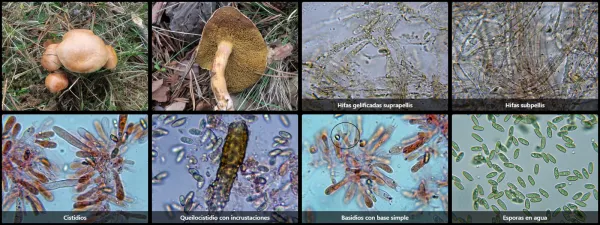

Suillus bovinus
Taxonomy
Main synonym
Common names
Boleto bovino, pinudietako behi-onddo, molleric.
Geographic references:
Interactive map with data from GBIF.

Morphological Features:
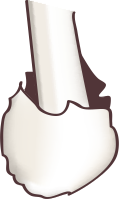
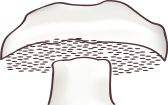
Pileus typically 5 to 10 cm in diameter, occasionally slightly larger, convex to plano-convex in shape, remaining flat only in its final stage. Its color is ochre within a range of shades that sometimes approaches yellow, but never darkens toward brownish tones. The cuticle is only glossy in dry weather, but becomes slightly viscid with rain; it is also difficult to separate from the pileal flesh. Margin involute and excurrent in young specimens, additionally thin and lighter in color than the rest of the pileus.
Tubes decurrent and short, subdivided and septate, somewhat elastic in consistency and inseparable from the pileal flesh. Pale matte yellow when young, later turning a rather unattractive olive-ochre tone.
Pores broad and angular, olive-colored with brownish or ochre tints.
Stipe solid and full, proportionate in size to the pileus, cylindrical but markedly attenuated at the base. Similar in color to the pileus except for a reddish base; usually curved.
Flesh thick but spongy, soft and rather tender, generally yellowish, sometimes slightly ochraceous. Taste sweet and mild, not pronounced, as is the odor.
Habitat:
A very frequent and abundant species that fruits during autumn. Forms mycorrhizae with various pine species, particularly Pinus silvestris and Pinus radiata. It can sometimes produce large clusters of fruiting bodies.
Observations:
Some authors mention the possible edibility of this species, rating it as mediocre, which we consider rather generous on their part, as it is practically inedible. In the section on possible confusions, we will also mention Suillus granulatus, which has smaller pores and a yellowish stipe with granulations on the upper portion.