

Strobilurus esculentus var. griseus
Taxonomy
Main synonym
Common names
Collybia comestible.
Geographic references:
Interactive map with data from GBIF.




Morphological Features:
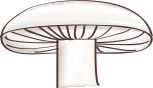
Pileus of small dimensions, in the adult stage barely reaching 2 to 4 cm in diameter; its initial shape is convex but tends to become plano-convex. The cuticle is completely smooth and of a uniform gray color. It may present a small umbo at the center, and the margin is incurved and non-striate.
Lamellae white or creamy-white in color, moderately spaced; attachment to the stipe is adnate to slightly decurrent.
Stipe long relative to the pileus size, cylindrical, concolorous or darker at the base and fading towards the pileus; it appears radicate at the basal region.
Flesh distinctly scanty, with a somewhat tenacious or elastic consistency, bearing a faint, mild fungal odor and a sweet taste.
Habitat:
As with the type species, it fruits attached to the cones of various spruce trees, though it may occasionally appear terrestrial. It is a spring-fruiting and relatively uncommon species.
Observations:
It is an edible spring mushroom with culinary characteristics identical to those of the type species, from which it is distinguished by the uniformly gray color of its pileus. This same feature differentiates it from other Strobilurus, all of which are more ochraceous. For further information, see the species account of the type species.
