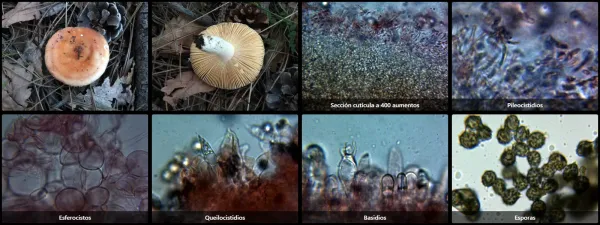

Russula rosea
Taxonomy
Main synonym
Common names
Rusula graciosa, gibelgorri hankagogor, puagra de sang de bou.
Geographic references:
Interactive map with data from GBIF.


Morphological Features:
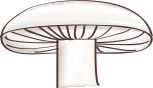
Pileus of medium size, reaching up to 10 cm in diameter at full development; initially globose, later convex, eventually flattening with a slightly depressed center. The surface is notably dry and non-stripping, initially displaying a fairly homogeneous matte red color, but fading considerably over time to yellowish-ochre tones; however, it is most commonly encountered red.
Lamellae not very crowded, whitish or pale cream in color. Free from the stipe, occasionally with a reddish-tinged lamellar margin.
Stipe central and cylindrical, so hard that it cannot be broken by squeezing with two fingers; sometimes entirely white, other times tinged reddish or pinkish, highly variable.
Flesh thick and firm, hard, white in color, with a distinct and defined odor that is not particularly pleasant, and a taste differing from other species of its genus; it imparts a somewhat dry sensation. However, despite having tasted it on countless occasions, we have never detected any mentholated flavor as noted by many authors.
Habitat:
In northern Iberia, this is a frequent and common mushroom that we encounter without difficulty each year, both in summer and autumn. We have always found it under broadleaf trees, particularly beeches.
Observations:
We have tasted it, and speaking from experience, we can say it is not particularly worthwhile, although some may enjoy it. There are multiple varieties of this species; we will highlight var. lactea, which is white, and var. speciosa, whose pileus fades to yellow. Others have been elevated to specific rank, such as Russula amarissima, characterized by a bitter taste, red lamellar margins, and a stipe that yellows; also Russula linnaei, with a dark pileus and vividly red lamellar margins. It is frequently confused with Russula aurora, which has a pink pileus with a yellowish-ochre center, a white stipe, and a mild, pleasant taste. Russula nobilis bears some resemblance, but its flesh is highly acrid.