
Russula nobilis
Taxonomy
Main synonym
Common names
Not available
Geographic references:
Interactive map with data from GBIF.



Morphological Features:
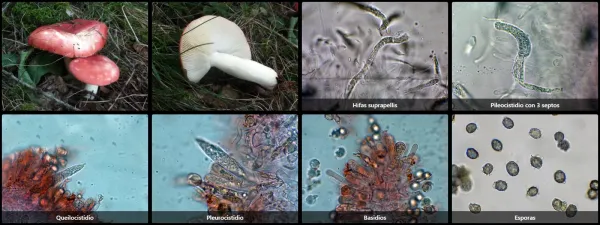
Pileus in mature specimens measures between 4 and 6 cm in diameter, occasionally slightly larger. Initially convex, it becomes broadly expanded for most of its development and finally somewhat depressed, particularly at the center. The pileal surface is easily separable, predominantly a more or less vivid red; in some specimens this color is very homogeneous, but in others it may fade with irregularly distributed cream-colored patches. To the naked eye, it appears smooth and glossy when wet, presenting a drier appearance under other weather conditions. The margin is smooth and slightly incurved in younger specimens, tending to become striate in mature ones.
Lamellae adnate and rather widely spaced, white with a concolorous edge. Lamellulae are scarce, and the arrangement is very regular. They curve slightly towards the stipe but never become emarginate.
Stipe variable in size depending on the substrate, cylindrical or slightly widened at the apex. White, with a tendency to stain yellowish-ochraceous upon handling. Solid when young, becoming cavernous later. The surface is smooth in young specimens and becomes more rugose in mature ones.
Flesh thick but brittle, rather fragile despite the fleshy appearance of the mushroom. White, with pinkish tinges on the subpileal surface. It emits a distinctly noticeable fruity odor and has an intensely pungent taste.
Habitat:
This is a common species in the beech forests of the northern peninsula, where it fruits in small but abundant groups during autumn. It may occasionally appear at other times of the year and is much less frequent in other habitats.
Observations:
Species within the Emiticinae group are very difficult to differentiate from one another. This species is characterized by its habitat in beech forest leaf litter, its intermediate stature, and its pileus which expands promptly. Russula emetica, the type species of this group, fruits primarily on peatlands associated with mountain conifers, has a larger stature and firmer texture, and its spores are larger. Russula silvestris is a smaller, more delicate species with a pileus that fades easily, exhibiting a muscicolous growth habit associated with various broadleaf trees. There are other less well-known but equally similar species whose differentiation relies on minor characters, generally microscopic, making this group truly challenging.