
Russula cyanoxantha
Taxonomy
Main synonym
Common names
Carbonera, urretxa, llora.
Geographic references:
Interactive map with data from GBIF.


Morphological Features:
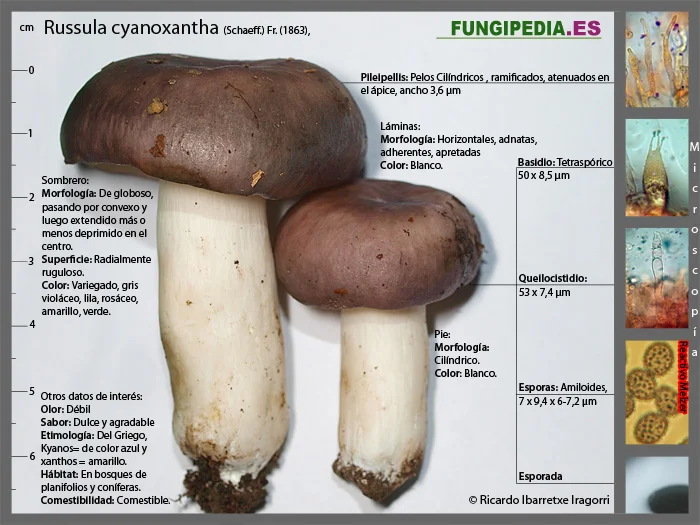
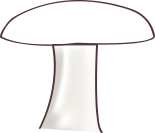
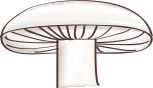
Pileus up to 15 cm in diameter, convex to flattened, typically umbilicate with a generally incurved margin, bearing a smooth, slightly to non-viscid, and separable cuticle. Color is of limited diagnostic value for identification in this case, as it is highly variable; specimens may exhibit violet, lilac, greenish, or even gray tones, but never red.
Lamellae adnate, white, and flexible, making them difficult to separate from the flesh; however, the most significant characteristic is their greasy feel to the touch.
Stipe central, cylindrical, and proportional to the pileus, white in color.
Flesh firm and brittle, a typical trait of Russula species, although the stipe flesh becomes slightly spongy over time. Its primary color is white, with a slight lilac tint beneath the cuticle; it possesses a mild fungal odor and a pleasant taste.
Habitat:
We have consistently located it beneath various broadleaf trees, particularly beech and oak, although some authors also report it under conifers. Its fruiting season occurs in summer and extends into mid-autumn.
Observations:
It is a choice edible, commonly collected in the Basque Country (Spain), where it is highly valued; however, experience indicates that many collectors confuse it with other species, such as Russula heterophylla, parazurea, grisea or vesca. It can be readily distinguished from these by simply touching the lamellae. The var. peltereaui exists, which is entirely green, and var. cutefracta, which features a cracked cuticle. Russula ionochlora is very similar; it also possesses lardaceous lamellae, albeit to a lesser degree, but its flesh is slightly acrid.

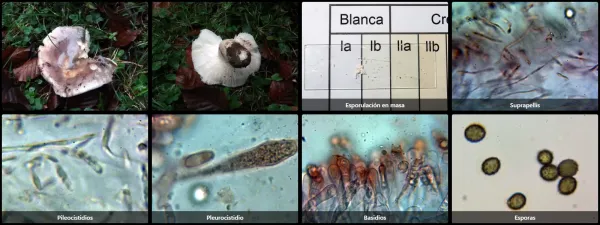
Microscopy of Russula cyanoxantha