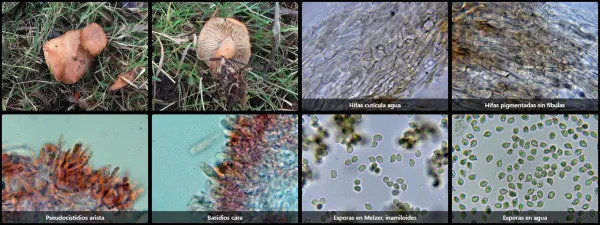

Clitopilus geminus
Taxonomy
Main synonym
Common names
Rojilla, gorritza, errotari marroi-arrosa.
Geographic references:
Interactive map with data from GBIF.



Morphological Features:
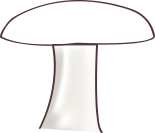
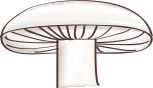
Pileus with a diameter ranging from 4 to 10 (12) cm; initially convex, it flattens towards the margin as it develops, frequently leaving the center prominently raised in the form of an obtuse umbo. Eventually, it becomes flat and may even become slightly depressed in age. The cuticle is smooth, with a color that varies depending on climatic conditions and ecology, but its chromatic base is always ochre, with reddish or pinkish tints in its most typical form. In early developmental stages, the margin is strongly incurved, gradually opening to become irregularly undulate in more mature specimens.
Lamellae slightly decurrent, with abundant lamellulae, crowded, narrow, and acute at the margin; whitish to cream-colored, becoming slightly pinkish due to sporulation.
Stipe somewhat short in young individuals and later proportionate to the pileus; solid and firm, generally smooth though pruinose at the apex, cylindrical, with variable coloration, whitish or matching the pileus.
Flesh thick and firm, white in color, sometimes with a pinkish tint in certain areas; odor pleasantly fungal with a farinaceous background, taste equally pleasant, perhaps with a hint of nuts.
Habitat:
This is a profoundly cosmopolitan species; we must enumerate numerous distinct habitats for it. It may fruit under conifers, broadleaf trees, various riparian trees, and, of course, in meadows or mountain grasslands, with the latter habitat perhaps yielding it most profusely. This species rarely fruits solitarily; it typically forms more or less numerous groups, lines, or fairy rings. Its preferred seasons for fruiting are spring and autumn.
Observations:
This species constitutes a fairly acceptable edible; it is fleshy and pleasantly flavored, and is collected in some regions under the vernacular name "rojilla". There has been some controversy regarding the separation of Rhodocybe truncata and gemina, but recent studies finally appear to distinguish them. Regarding potential confusion, its notable resemblance to Leucopaxillus gentianeus should be highlighted, which features consistently white and adnate lamellae, a pronounced farinaceous odor, and an extremely bitter taste.