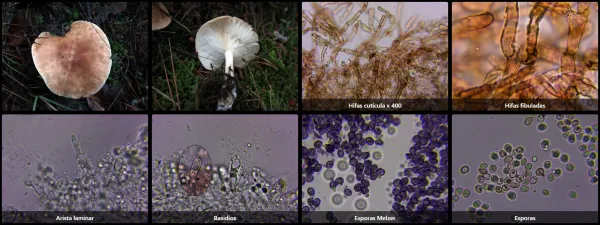
Leucopaxillus gentianeus
Taxonomy
Main synonym
Common names
Seta amarga, bitigar mingots.
Geographic references:
Interactive map with data from GBIF.




Morphological Features:
Pileus may exceed 10 cm in diameter, though mature specimens most commonly measure between 5 and 10 cm. It is convex for much of its development, later becoming plano-convex, with older specimens sometimes becoming somewhat depressed. The cuticle is felted in young specimens and subsequently smooth, ranging from reddish-brown to pale brown, quite uniform without significant color variation within a single specimen. The margin is initially involute and later straight, often striate or grooved, though this is a variable character as the margin may be smooth in some specimens.
Lamellae adnate and quite crowded, occasionally slightly sinuate, of a striking pure white color throughout most of their development, only turning creamy at the very end. They separate from the pileal flesh with great ease.
Stipe generally cylindrical, though in some cases it widens toward the base, and may even become clavate in certain specimens. It is solid and firm, whitish in color but not as pure white as the lamellae.
Flesh thick and firm, white and invariable, with a slightly farinaceous odor and a very bitter taste, even extremely bitter in the cuticle.
Habitat:
This species is very common and abundant, growing in fairy rings or lines. In some pine forests it can form true carpets during autumn; it also appears less profusely in broadleaf forests and under other conifers besides pine, such as firs or cedars.
Observations:
This species presents a fleshy and appealing appearance, with an even pleasant odor; however, it is unfortunately very bitter, a trait quickly verified by merely touching the cuticle with the tongue. Compared to other species within its genus, it is considered unmistakable; the color contrast between the cuticle and the pure white lamellae, combined with its extreme bitterness, readily distinguishes it. Inexperienced amateurs may confuse it with certain brown Tricholoma species, all of which possess emarginate rather than adnate lamellae.