
Pleurotus ostreatus
Taxonomy
Main synonym
Common names
Seta ostra, seta de concha, belarri landu, orellana.
Geographic references:
Interactive map with data from GBIF.





Morphological Features:
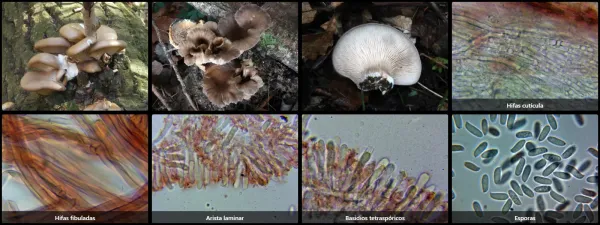
Pileus of variable size, with developed individuals measuring 5 cm and others exceeding 15 cm, typically oyster-shaped. The color of this fungus is highly variable; specimens commonly encountered are typically gray or grayish-ochre, although silver-gray, greenish-blue, and even brownish forms exist, often leading to the description of multiple varieties. Its cuticle is smooth, separable, and glossy, particularly when slightly viscid after rain. The margin is incurved in young specimens, later becoming thin and somewhat undulate.
Lamellae strongly decurrent, whitish in color, becoming slightly creamy with age, crowded and somewhat irregular in spacing.
Stipe short and entirely lateral; in some individuals it is barely perceptible due to being embedded in the substrate. It is similar in color to the lamellae.
Flesh firm and tough, white in color, with a mild fungal odor and a sweet, pleasant taste.
Habitat:
A frequent species in beech forests, fruiting in gregarious to even cespitose clusters on long-fallen trees. Varieties exist that fruit on poplar or elm stumps, and another that grows on conifers; however, the latter is uncommon.
Observations:
This fungus is readily recognizable to enthusiasts as the species commonly sold cultivated in trays in supermarkets worldwide. It is, however, frequently encountered in nature and constitutes a choice edible. The greenish var. columbinus, which grows on conifers, is slightly laxative and therefore not recommended for consumption. Pleurotus cornucopiae is frequently confused with this fungus, from which it differs by its striate stipe and mealy odor. Confusion is also possible with Pleurotus pulmonarius, which is whiter in color and has a mildly acidulous taste.