
Pleurotus eryngii
Taxonomy
Main synonym
Common names
Seta de cardo, gardu ziza, gírgola de panical.
Geographic references:
Interactive map with data from GBIF.



Morphological Features:
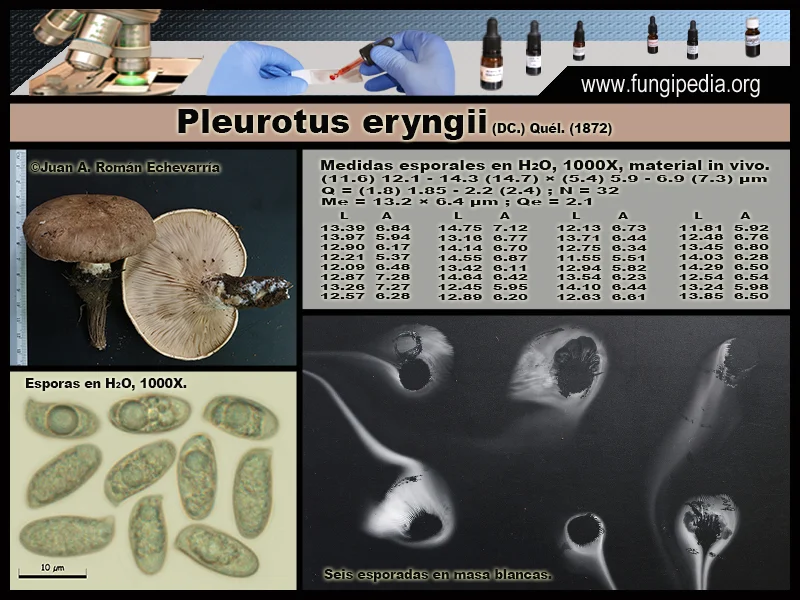
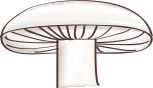
Pileus not particularly large, adult specimens range from 5 to 10 cm in diameter. Initially convex, it soon tends to flatten and may become slightly depressed in the center. Its color is highly variable; we have collected specimens ranging from very dark brown to light ochre. The surface is slightly scaly when young, becoming smooth with age; the margin remains incurved in young specimens but becomes thin and undulate in maturity.
Lamellae strongly decurrent, a defining characteristic of the genus Pleurotus, crowded, with interspersed lamellulae. Whitish in young specimens, later becoming grayish or light ochre.
Stipe rather short and pale, darkening somewhat with age. Generally eccentric, sometimes lateral; a central attachment is much rarer. Solid throughout development, attached at the base to thistle roots.
Flesh firm, thick, and consistent, though slightly elastic, white in color. The odor is mild and faintly perceptible, while the taste is sweet and pleasant.
Habitat:
Typically fruits first in spring, with a second flush occurring in autumn. Always associated with the roots of thistles and various Apiaceae (umbellifers), found in fallow fields, uncultivated areas, and ditches, generally wherever host plants grow. Frequent and widespread across many regions of our geography.
Observations:
A well-known and commonly collected mushroom, highly prized for culinary use, which is hardly surprising given its excellent flavor. Collected since time immemorial in many areas, it is now also commercially cultivated and available in markets. A closely related species, Pleurotus nebrodensis, is larger and white, fruiting on umbellifers. Several varieties exist: var. ferulae, which is cream-colored and twice the size, grows on Ferula communis; var. elaeoselini occurs on Elaeoselinum asclepium; and var. Thapsiae fruits on Thapsia villosa and Thapsia garganica. The toxic species Clitocybe rivulosa may be found in the same habitats; it has a short stipe and a whitish pileus.

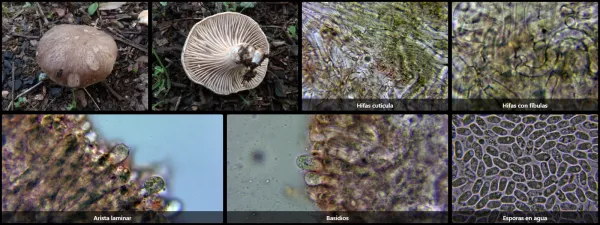
Microscopy of Pleurotus eryngii