
Microglossum nudipes
Taxonomy
Main synonym
Common names
Not available
Geographic references:
Interactive map with data from GBIF.

Morphological Features:
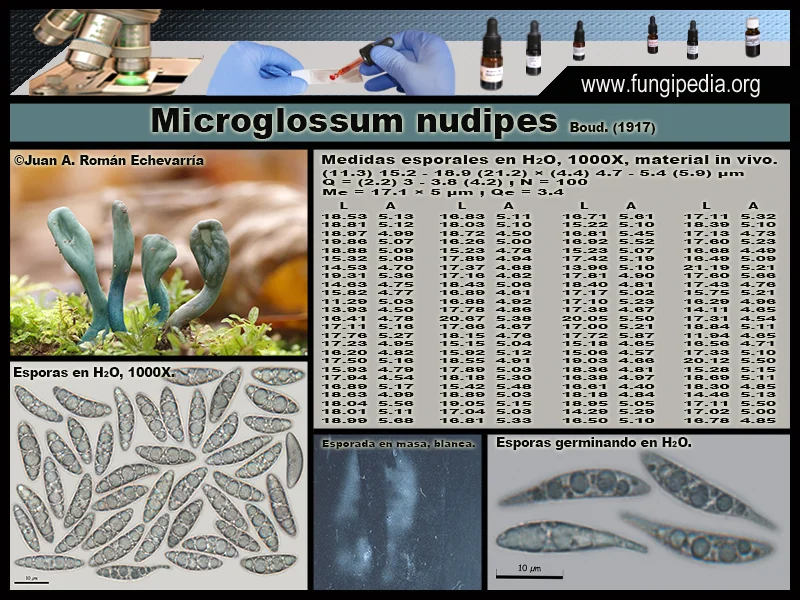
Carpophore stylized and clavate in shape, often straight but sometimes with variable development, adopting more twisted and imperfect forms, reaching a height that can slightly exceed 5 cm. It is clearly differentiated into two parts: an upper portion shaped like a clava or narrow spatula, and a lower portion or stipe, which is rounded and smooth. The upper zone is fertile and exhibits highly variable coloration; most commonly dark green, but also displaying other brownish or occasionally violet hues. It presents a longitudinal fissure even in young specimens, typically by a single sulcus, or occasionally by several, and bears an irregular, flattened, or sometimes blunt apex. Surface dry or shiny when wet, but never viscous.
Hymenium smooth, located on the upper zone of the carpophore, which can occupy practically half of its length; produces octosporic amyloid asci with croziers and sub-fusiform spores bearing a guttule (see microscopic features).
Stipe cylindrical and smooth, glabrous, generally solid to pithy. In the most typical specimens, it ranges from turquoise to dark green in color, though subject to some color variability. It differentiates well from the clava, although it lacks a regular demarcating sulcus, instead transitioning irregularly.
Flesh somewhat elastic but brittle, lighter in color than the external surface, even whitish at the center, but staining towards the margin with the exterior color. Odor neutral; completely tasteless.
Habitat:
Species located in Larrabetzu (Bizkaia), among leaf litter and soil, in mixed woodland with the presence of Laurus nobilis (bay laurel), Corylus avellana (common hazel) and Quercus robur (pedunculate oak). It typically fruits in more or less numerous groups, and is a cold-preferring species, with its peak appearance occurring in late autumn and early winter. Bibliographically, a more heliophilous habitat is referenced for it, which contradicts our field collections. Despite its gregarious habit, it remains an uncommon species.
Observations:
We are dealing with the genus Microglossum, which is somewhat controversial, subject to constant taxonomic revision, and open to further research. It comprises species that are often macroscopically very similar and can only be reliably differentiated through thorough microscopic and molecular studies. Such is the case of the species described in this profile, which has been sequenced to corroborate the macroscopic and microscopic findings. Microglossum viride and griseoviride are highly similar to this taxon, but their stipe is furfuraceous and they lack such marked differentiation between clava and stipe. Microglossum tenebrosus is also very similar, representing another taxon assigned to this species complex. Further taxonomic updates regarding the genus will undoubtedly emerge in the future.
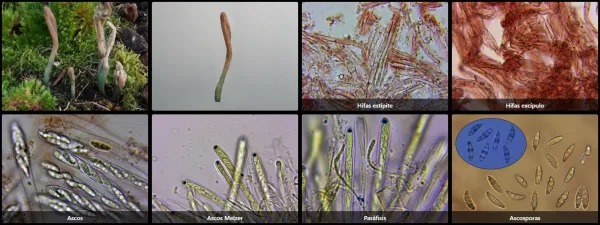
Microscopy of Microglossum nudipes