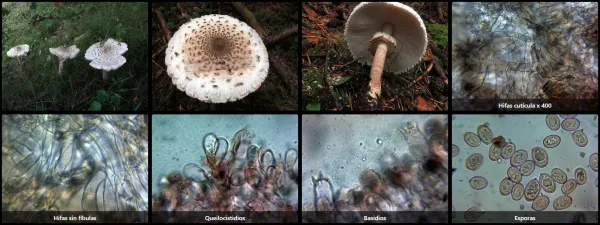
Macrolepiota procera
Taxonomy
Main synonym
Common names
Galanperna, apagador, matacandelas.
Geographic references:
Interactive map with data from GBIF.




Morphological Features:
Pileus of large dimensions; specimens up to 40 cm in diameter have been collected. Initially globose and closed over the stipe, resembling a microphone or a bass drum mallet, later expanding and provided with an obtuse umbo. Covered with brown scales on a white-cream background, with the center distinctly brown.
Lamellae whitish, broad, and somewhat ventricose, free from the stipe or slightly notched.
Stipe long and cylindrical, terminating in a bulb at the base, hollow and woody in consistency, with a tiger-striped appearance due to being covered with brown fibers on a lighter background. Provided with a movable white ring, slightly brownish beneath.
Flesh tender and white in the pileus, hard and woody in the stipe, with a mild odor and a pleasant nutty flavor.
Habitat:
Appears from late summer onwards in grassy clearings of pine forests, beechwoods, and open meadows. Abundant and widely distributed.
Observations:
The pilei of this species constitute an acceptable edible. It is the largest Macrolepiota, all its "cousins" being smaller in size. The var. permixta exists, currently separated as a distinct species under the name Macrolepiota fuliginosa, which is more heavily scaled and has a smooth, variegated stipe. All poisonous Lepiota species are small in size, with the exception of Chlorophyllum molybdites, a species abundant in America and rarely reported in Europe.