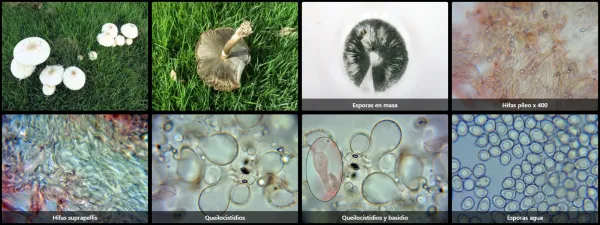

Chlorophyllum molybdites
Taxonomy
Main synonym
Common names
Parasol falso, sombrilla de esporas verdes.
Geographic references:
Interactive map with data from GBIF.


Morphological Features:
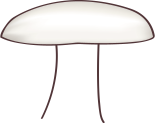
Pileus of substantial size, usually exceeding 20 cm in diameter, although specimens measuring 30 cm or more are not uncommon. Initially attached to the stipe, club-shaped with a flattened apex, but expands from convex to flat. Whitish in color, bearing a broad, star-shaped scale at the apex that breaks up into floccose scales over the remainder of the surface.
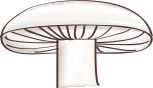
Lamellae free from the stipe, whitish when young, later acquiring greenish tones due to sporulation, and eventually turning brown. They are considerably more crowded than is typical for Macrolepiota species. Spore print pale green.
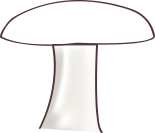
Stipe cylindrical and elongated, may exceed 20 cm in height, central with a bulbous base. Whitish or beige when young, but gradually becomes reddish-brown from the base upwards. Bears a double, movable, whitish ring (annulus). Fibrillose and fistulose.
Flesh relatively thick, white, and fibrous in the stipe; slightly reddening when cut or yellowing upon friction. Sweet-tasting with a faint odor.
Habitat:
A species that fruits rapidly following rainfall during both summer and autumn. Occurs in lawns, grasslands, and ruderal areas, even in gardens. Widely distributed across the American continent, from California to Argentina; records on other continents are sporadic.
Observations:
A toxic species that causes severe gastrointestinal disturbances; although short-lived, the severity depends on the individual and the amount ingested. We have noted that different size ranges are reported for this species depending on the region; in some areas it is claimed not to exceed 15 cm, which most likely represents regional varieties of the same species. It may be confused with the European Macrolepiota procera, which has a tiger-striped stipe and white spores, as well as with Chlorophyllum rachodes, which is more reddening and scaly, or Macrolepiota konradii, which bears a single ring and equally white spores. Other edible Macrolepiota species occur in the same region, such as Macrolepiota bonaerensis, but none possess a pale green spore print.