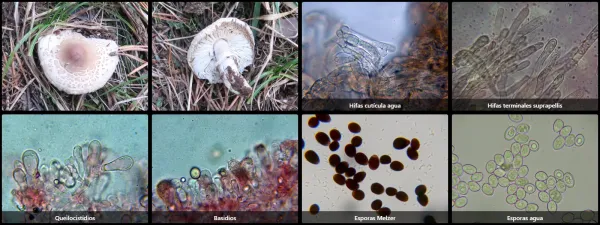

Macrolepiota mastoidea
Taxonomy
Main synonym
Common names
Apagador mamelonado, parasol, galanperna puntaduna, cogomella de mugró.
Geographic references:
Interactive map with data from GBIF.




Morphological Features:
Pileus whose shape evolves throughout its development from an initially conical to a campanulate form, finally expanding while retaining a very prominent, pointed umbo at the center. In this final expanded stage, it can reach up to 12 cm in diameter, although specimens of merely 7 or 8 cm may be found. Its cuticle is initially quite uniformly ochraceous; as it matures, it exfoliates into scales that gradually separate, revealing a more cream-colored background beneath, while the central area and consequently the umbo retain the original coloration, with these scales being much more widely spaced toward the margin. The margin is regular and may bear ragged remnants of the universal veil in young specimens.
Lamellae free and rather crowded, white in color, later becoming somewhat cream-colored and occasionally staining brownish with age; they are relatively thick.
Stipe long and cylindrical, though it may be somewhat attenuated at the apex and bulbous at the base. Its surface is pale brown over a whitish or cream background, mottled or scaly, quite fibrous, and hollow. It bears a simple, membranous, movable ring that is white, although its outer face may be brown.
Flesh relatively thick, whitish in color; tender in the pileus, hard and fibrous in the stipe, which is woody. It has a mild fungal odor and a pleasant, sweet taste.
Habitat:
This species fruits in herbaceous areas, meadows, and grasslands, occasionally also in woodland clearings, but it does not typically occur within forests proper. It is primarily an autumnal species that generally appears in small groups or solitarily, and is not as common as Macrolepiota procera.
Observations:
A medium-sized species within the genus, it does not reach the dimensions of Macrolepiota procera, which has a tiger-striped stipe and lacks a pointed umbo. Another similar species with an obtuse umbo is Macrolepiota gracilenta, which possesses a double ring. Caution must be exercised not to collect small-sized Lepiota species, many of which are toxic or deadly; numerous cases of poisoning by Lepiota brunneoincarnata have occurred in recent times, a potentially lethal species. Chlorophyllum molybdites is a toxic species with a greenish spore print and a stipe that is not tiger-striped.