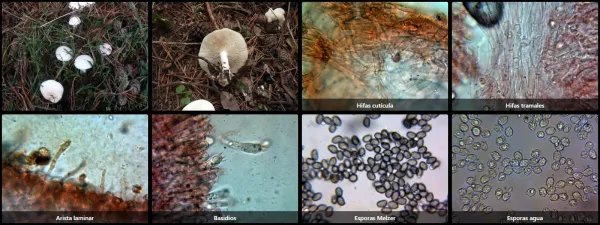
Leucopaxillus paradoxus
Taxonomy
Main synonym
Common names
Not available
Geographic references:
Interactive map with data from GBIF.




Morphological Features:
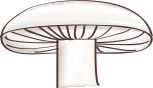
Pileus up to over 10 cm in diameter in well-developed specimens, hemispherical at first but soon becoming convex, finally irregularly flattened, lobed, or slightly depressed, though it typically does not become infundibuliform. The cuticle is initially whitish, developing creamy tones with yellowish hues, and occasionally ochraceous towards the center; it does not separate easily from the flesh. Surface dry, generally smooth and glabrous, tending to crack when humidity is low. Margin involute for much of its development, becoming extended and undulate in mature specimens.
Lamellae decurrent, less crowded than in other species of its genus, unequal, white, becoming creamy at maturity.
Stipe solid, full, proportional to the pileus or short, thickened at the base especially in young specimens, otherwise cylindrical, whitish but capable of acquiring the same tones as the pileus, particularly from the base upwards.
Flesh thick and substantial, very firm in both the pileus and stipe, white. Odor pleasant, fungal or slightly acidulous; taste bitter, sometimes initially sweet and becoming bitter later.
Habitat:
This species fruits in both coniferous and broadleaf forests; in the former, it typically forms dense clusters of numerous specimens and is more common, whereas it is rarer under various broadleaf trees. It fruits primarily during autumn.
Observations:
Its flesh is bitter, although the bitterness may sometimes be delayed; we consider this makes it poorly suited for culinary use. Despite some authors classifying it as edible, we regard it as without culinary value. Clitocybe candida is a similar species, but it has a stronger odor, a separable cuticle, becomes infundibuliform in maturity, and its pileus remains white. The toxic species Pseudoclitopilus rhodoleucus also shares some resemblance; its lamellae are initially pink and its pileus is always white. Confusion with other white Clitocybe species such as Clitocybe phyllophila or Clitocybe rivulosa, among others, is equally hazardous.