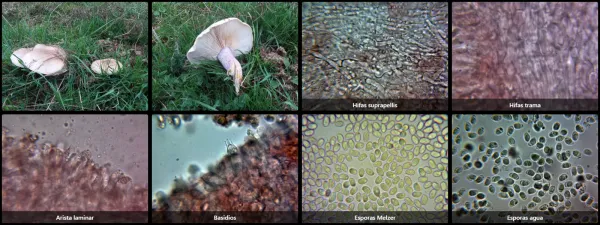
Lepista personata
Taxonomy
Main synonym
Common names
Pie violeta.
Geographic references:
Interactive map with data from GBIF.




Morphological Features:
Pileus which can exceed 10 cm in diameter, convex to flattened, fleshy and substantial, with a sinuous or undulate margin slightly incurved, smooth and grayish-beige in color, somewhat fading upon drying, but uniform.
Lamellae crowded and slightly sinuous, attached to the stipe, and beige in color, sometimes with pinkish tinges.
Stipe violet in color, highly conspicuous, contrasting with the rest of the carpophore, generally short but substantial, cylindrical and slightly bulbous near the base where it attaches to the mycelium.
Flesh pale, whitish, sometimes with violet tinges, with a non-offensive but somewhat strong odor that contrasts with its mild flavor.
Habitat:
A late-season species that tolerates cold very well, so it usually does not appear until November and persists well into winter. Its natural habitat consists of mountain meadows or alpine pastures, although it also occurs at the edges of pine forests, albeit less abundantly.
Observations:
This species constitutes a good edible, and in our humble opinion is superior to Lepista nuda. Many people who consult us confuse these two species, and we do not understand why; one has a completely violet carpophore, whereas Lepista personata only has a violet stipe.