Lepista panaeolus
Taxonomy
Main synonym
Common names
Seta de brezo, tricoloma de prado, larramendi ziza, moixernó de tardor.
Geographic references:
Interactive map with data from GBIF.




Morphological Features:
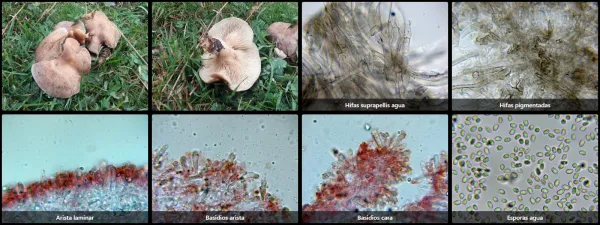
Pileus up to over 10 cm in diameter, though typically found between 5 and 10 cm; convex for much of its development, eventually becoming flattened. Light gray in color, sometimes whitish toward the margin, and frequently bearing more or less concentric darker spots compared to the rest of the pileal surface. The margin is usually markedly sinuate and inflexed when young. Surface dry or shiny when wet, never viscid, smooth.
Lamellae adnate to slightly emarginate, whitish in young specimens, later light gray, occasionally developing a pinkish or yellowish tinge with age. Rather crowded, sinuate or arcuate, and notably characterized by detaching very easily from the pileal flesh.
Stipe central and cylindrical, whitish or lighter gray than the pileus. Surface slightly fibrillose and very dry; solid and fleshy.
Flesh relatively thick and tender, whitish or pale gray in color, somewhat brittle in consistency, especially in the pileus, slightly more fibrous in the stipe. Odor distinct, pronounced, and pleasant; taste when raw is mildly peppery but not unpleasant.
Habitat:
Typically appears in rows or fairy rings, in mountain grasslands, meadows, and open fields in general; also occurs in lowland areas, not exclusively in mountains. A frequent and widely distributed autumn mushroom.
Observations:
This species is a good edible; its peppery taste, particularly when raw, does not pose a significant issue for consumption—simply refraining from adding extra chili peppers to the dish is sufficient. Furthermore, its flavor and texture are highly palatable. Some authors tend to synonymize it with Lepista rickenii, which features a browner pileus, a farinaceous odor, and adnate to slightly decurrent lamellae. Lepista caespitosa is smaller and, as its name indicates, exhibits a cespitose growth habit. Lepista irina may bear some resemblance, but its strong perfumed odor readily distinguishes it. Among toxic species, Clitocybe phyllophila can be confused due to its spotting, but it is more whitish and its lamellae do not detach easily.