
Clitocybe phyllophila
Taxonomy
Main synonym
Common names
Not available
Geographic references:
Interactive map with data from GBIF.


Morphological Features:
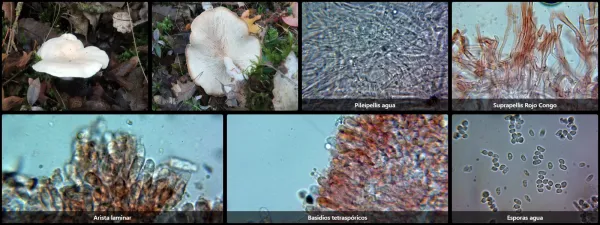
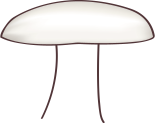
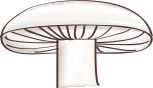
Pileus of intermediate dimensions, usually exceeding 5 cm in diameter but not reaching 10 cm; convex in its early developmental stage, later flattening out while retaining an obtuse umbo in the central region. Fundamentally white in color, though covered with a whitish pruina that tends to take on a slight pinkish hue under certain climatic conditions, or acquires creamy tones. The margin is quite regular.
Lamellae slightly decurrent, unlike other species of its genus which are much more strongly decurrent. White in color, becoming somewhat creamy with age.
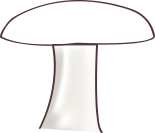
Stipe central and cylindrical, quite thick and proportionate to the size of the pileus. Whitish in color, but taking on a creamy hue starting from the base.
Flesh relatively thick and white in color, with a mild and pleasant fungal odor, and a good taste, sweet and slightly farinaceous.
Habitat:
Contrary to some opinions, we consider that it fruits equally under conifers and broadleaf trees; we have also observed it beneath riparian trees such as alders. It is eminently autumnal and quite frequent.
Observations:
This species was already regarded by Singer as a synonym of Clitocybe pithyopila, which in turn has been synonymized with Clitocybe cerussata; currently, both taxa are unified under the name we present here. We also do not consider the habitat to be particularly relevant, nor is the spore print color, which has been demonstrated to vary under extreme climatic conditions. It is a highly toxic species with a good flavor; caution should be exercised to avoid confusion with Clitopilus prunulus or Clitocybe nebularis, which are edible species, the former characterized by a pink spore print and strongly decurrent lamellae, and the latter by a very characteristic odor.