
Lactarius semisanguifluus
Taxonomy
Main synonym
Common names
Esnegorrikor.
Geographic references:
Interactive map with data from GBIF.


Morphological Features:
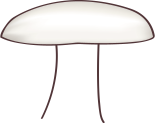
Pileus of variable size; some adult specimens do not exceed 3 to 4 cm in diameter, with it being common to find them measuring between 5 and 10 cm, rarely exceeding this dimension. Initially convex, then flattened with a slightly depressed center, and finally becoming infundibulate. The surface is matte, pale orange with faint concentric zones, rapidly turning greenish with some grayish tinge and areas of darker green. The margin is incurved in young specimens, later becoming thin and quite regular, slightly undulate.
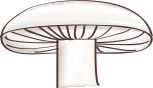
Lamellae adnate to slightly decurrent, pale orange, with lamellulae and often forked towards the stipe. They turn wine-red at injuries as the latex exuding onto them dries, sometimes appearing practically reddish in certain cases. When old, these lamellae also turn green.
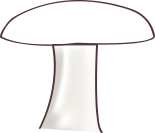
Stipe well-proportioned and cylindrical, similar in color to the pileus or somewhat paler if anything, usually tapering towards the base and slightly scrobiculate. Solid when young, but quickly becoming hollow; like the rest of the basidiocarp, it tends to turn green.
Flesh compact and thick, whitish in the center and orange towards the periphery; exudes a latex that is carrot-orange upon cutting, but turns wine-red after drying for a few minutes. The odor is pleasant and fruity; the raw taste is slightly acrid, an acridity that is not unpleasant and disappears upon cooking.
Habitat:
This is a fairly common species that grows in coniferous forests; it is usually seen abundantly in Pinus sylvestris woodlands. It is predominantly autumnal and rarely grows isolated, being more commonly found in groups of several specimens.
Observations:
The section dapetes (orange latex) within Lactarius comprises species that are very similar to one another, all being edible though of varying quality. The species presented here is characterized by its pileus turning green and its orange latex, which turns wine-red after a few minutes both upon cutting and on the lamellae. Lactarius sanguifluus has wine-red latex upon cutting, an orange-ochraceous pileus, and reddish lamellae. Lactarius deliciosus has a bright orange, non-matte pileus, and its carrot-colored latex does not turn reddish. Do not confuse with the toxic species Lactarius torminosus.
