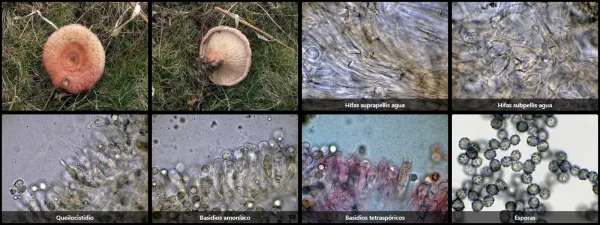
Lactarius torminosus
Taxonomy
Main synonym
Common names
Níscalo falso, nícalo lanoso, esnegorri faltsua, rovelló de cabra.
Geographic references:
Interactive map with data from GBIF.




Morphological Features:
Pileus which at its maximum development can exceed 10 cm in diameter, distinctly convex for most of its development, but with a central depression that persists and even becomes more pronounced at maturity, when it usually flattens or becomes slightly infundibuliform. Its cuticle is predominantly reddish, featuring concentric zones where red alternates with creamier lines, and is covered by dense pilosity giving it a woolly appearance; this covering may disappear with age. The margin is incurved in young specimens and later becomes even, the woolly covering being more pronounced on it than on the rest of the pileus.
Lamellae decurrent, closely spaced, rather narrow, cream-colored in most cases, becoming ochraceous with age and showing pinkish reflections when young.
Stipe proportionate to the pileus, central and cylindrical, slightly attenuated at the base in some specimens, solid when young and later hollow, pale in color, whitish when the mushroom is young, adopting pinkish or flesh-toned hues over time. It usually bears pinkish scrobiculae, though not in all specimens.
Flesh firm and white, thick, occasionally acquiring pinkish tones. Exudes a latex that is white and invariable to air and on the lamellae; it only turns yellowish on a handkerchief. This latex is pungent. It has a pleasant fruity odor and a markedly acrid taste.
Habitat:
A species that forms mycorrhizae exclusively with birches, growing predominantly in mountainous areas. The collected specimens were found in a mixed forest of birch, oak, and beech, forming fairy rings or rows of numerous individuals. It is not a frequently encountered species due to its exclusive habitat, fruiting primarily during autumn.
Observations:
This Lactarius causes serious gastrointestinal disturbances and is characterized by its reddish coloration, concentrically zoned woolly cuticle, white invariable latex, and exclusive habitat under mountain birches. Lactarius pubescens, also associated with birches, lacks zonation and has a paler cuticle ranging from whitish to cream, and is equally toxic. In other habitats, Lactarius mairei and Lactarius tesquorum occur, which also share some similarities; the former grows under broadleaf trees and the latter exclusively under Cistus shrubs. Do not confuse with chanterelles, which have orange latex, never white.