

Lactarius sanguifluus
Taxonomy
Main synonym
Common names
Níscalo, nícalo, rovelló, lactario de sangre, esneardotsu.
Geographic references:
Interactive map with data from GBIF.




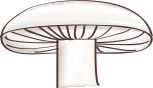
Morphological Features:
Pileus with a diameter that can range in adult specimens between 5 and 10 cm, occasionally somewhat larger. It usually exhibits a convex shape for much of its development, with an umbilicate center, later flattening considerably, but this species typically does not become infundibuliform. Its surface is dry, felted when young and subsequently smooth and glabrous, pale ochraceous with a slight orange tinge, but never distinctly orange; in many specimens it is not zoned at all, while in others it is vaguely zoned. Margin incurved in young individuals, later extended and regular.
Lamellae somewhat decurrent, unequal in configuration, fairly crowded and interspersed with lamellulae; initially pale, ranging from ochraceous to orange, soon acquiring wine-red or purplish tones. They exude a wine-red latex when injured.
Stipe generally short, robust in appearance, solid in young specimens and later hollow, light-colored, sometimes nearly white but with a purplish tinge; the presence of dark wine-red scrobiculi is common.
Flesh thick and solid, pale ochraceous, sometimes nearly white, stained upon cutting by the exuding latex, which is wine-red and turns purple upon drying. Its odor is pleasant and its taste mild, though slightly pungent when raw.
Habitat:
A common and frequent species in some areas and virtually absent in others, it fruits exclusively forming mycorrhizae with pines; we commonly observe it abundantly under Pinus sylvestris at altitudes between 700 and 900 meters. In other regions, it is common in pine forests with heaths. It is an eminently autumnal mushroom.
Observations:
Highly prized culinarily across wide areas of the Spanish landscape, it is a choice edible; some consider it the finest of the milk-caps. We regard its quality as comparable to that of Lactarius deliciosus, which features a brightly orange, zoned pileus and unchanging orange latex. Other taxa exist within the Dapetes subsection: some are well-defined, such as Lactarius semisanguifluus, with orange latex that turns wine-red after a few minutes upon drying; others are more controversial, like Lactarius violaceus or Lactarius vinosus, which may represent the same species or varieties of the present one. Lactarius salmonicolor is clearly distinguished by its occurrence under spruces and its uniform salmon color that never stains green; in that same habitat, Lactarius deterrimus occurs, which has a somewhat bitter as well as pungent taste and does stain green at injury sites. Lactarius quieticolor possesses a pale pileus due to abundant pruina, and Lactarius hemicyaneus is a form of the latter whose flesh turns violet upon exposure to air. The toxic species Lactarius torminosus has white latex.
