
Laccaria bicolor
Taxonomy
Main synonym
Common names
Lacaria de dos colores.
Geographic references:
Interactive map with data from GBIF.


Morphological Features:
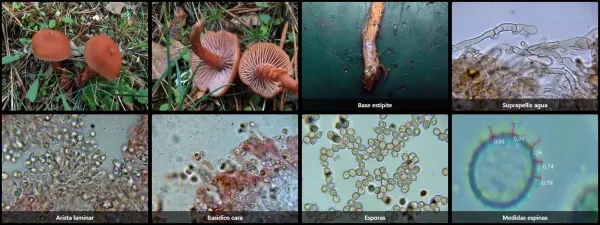
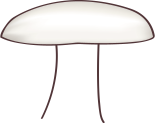
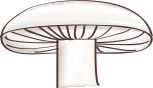
Pileus in adult specimens ranges from 2 to 5 cm in diameter, generally convex to plano-convex, sometimes slightly depressed in more mature specimens. Its surface is slightly scaly, especially in young individuals, tending to become smooth and glabrous over time and with the effects of rain. Its color varies depending on its hydration level: brownish-ochre with reddish tints when moist, fading to lighter ochraceous tones upon drying. The margin is somewhat radially striate by transparency, more pronounced in dry specimens, and becomes notably undulate with age.
Lamellae adnate, lilac in young specimens, later pinkish-flesh-colored, thick, relatively distant from each other, and with numerous lamellulae.
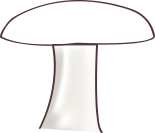
Stipe generally elongated and slender, longer than the pileus diameter, although this is a somewhat variable character. It is fibrillose, a feature that becomes more pronounced in the upper third, and even slightly grooved. Its color is similar to that of the pileus except at the base, which acquires a violet hue due to the transmission of this color from the mycelium.
Flesh scanty and thin, pinkish-ochre in color except at the stipe base where it is amethystine. It has a faint, fungoid odor and a sweet, mild taste.
Habitat:
This species is considerably less common than other species of its genus; it generally fruits gregariously in humid forests with humus-rich soils. It can be found under broadleaf trees, although we more commonly observe it under various conifers, producing an initial flush in spring and fruiting more abundantly during autumn.
Observations:
Traditionally, Laccaria farinacea has been separated from the species presented here, but we consider them to be conspecific, as the lamellae appear more lilac or pinkish depending on specimen maturity. Laccaria laccata is very similar, but the mycelium is white and the stipe base therefore does not acquire violaceous tones. There are other species in this genus with which it can be confused, requiring a detailed study for accurate identification. It may also be confused with Mycena pura, a toxic species with violaceous tones but white lamellae.