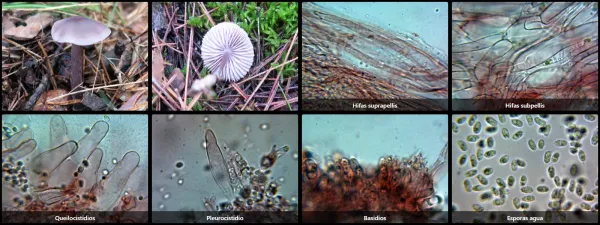
Mycena pura
Taxonomy
Main synonym
Common names
Micena pura, kampaitso arbiusain.
Geographic references:
Interactive map with data from GBIF.




Morphological Features:
Pileus small, at best barely reaching 5 cm in diameter, conical or bell-shaped in its early stage, subsequently convex and finally flattened, sometimes slightly umbo-nate. Its surface is smooth and shiny when wet, but not viscid; color is highly variable as it is a markedly hygrophanous species. The typical form displays a beautiful violet hue, somewhat fading toward the margin, but forms or varieties exist with colors as diverse as tawny, yellow, lilac, pink, or whitish. The margin is fairly regular, initially incurved and later straight, striate by transparency.
Lamellae adnate and very distant, ventricose and with lamellulae, generally whitish though they may exhibit a lilac or pinkish tinge.
Stipe cylindrical and well-proportioned, hollow, often with a translucent appearance; similar in color to the pileus, with a cottony base where it joins the mycelium.
Flesh scant and soft, whitish in color, very fragile; possesses a marked radish-like odor and a similarly radish-like taste.
Habitat:
A species with a wide distribution both geographically and ecologically, it fruits equally in coniferous and broadleaf forests, typically appearing in small groups on the ground. It is a very abundant and frequent species in our forests, typically fruiting during both summer and autumn.
Observations:
This is a mushroom containing psychotropic substances; furthermore, muscarine has been detected in some of its varieties, making it certainly toxic. The color variability exhibited by this species is so great that numerous varieties have been described, some of which have attained specific rank. Thus, we find Mycena rosea, larger in stature with a pinkish color throughout the fruitbody; Mycena diosma, a small mushroom with a floral rather than radish-like odor; or Mycena pearsoniana, which differs by subtle traits such as the amyloid nature of its spores. Another well-differentiated species is Mycena pelianthina, with lilac lamellae bearing a dark edge, and which is clearly distinguished under the microscope by the presence of cheilocystidia.