
Laccaria amethystina
Taxonomy
Main synonym
Common names
Lacaria amatista.
Geographic references:
Interactive map with data from GBIF.


Morphological Features:
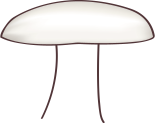
Pileus reaching up to 5 cm in diameter, of a striking violet color. It is somewhat hygrophanous, a trait that causes its color to fade to nearly whitish upon drying. During development, it changes from convex to plane, eventually becoming depressed in age; the margin is irregularly lobed.
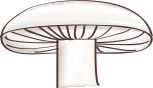
Lamellae adnate to slightly decurrent, concolorous or, if anything, more strikingly violet than the pileus, distant and sometimes somewhat thickened.
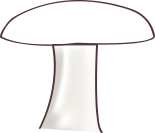
Stipe central, cylindrical and elongated, similarly violet in color, though usually somewhat paler than the pileus, particularly near the lamellae. It is longitudinally striate, sometimes faintly so.
Flesh violet, as in the rest of the basidiocarp, rather fibrous and thin, with a mild fungal odor and a sweet taste.
Habitat:
This species fruits in mossy and humid forest areas, both under conifers and broadleaf trees, often in large groups. Frequent and abundant.
Observations:
This is a mediocre edible, yet otherwise beautiful species, notable for its uniform violet coloration, a feature that distinguishes it from related species such as Laccaria laccata, Laccaria proxima, or Laccaria bicolor; the latter also has violet lamellae but the remainder of the basidiocarp exhibits ochre tones. Mycena pura is a bluish species, but with white rather than lilac lamellae.
