
Infundibulicybe geotropa
Taxonomy
Main synonym
Common names
Platera, San Martin ziza.
Geographic references:
Interactive map with data from GBIF.


Morphological Features:
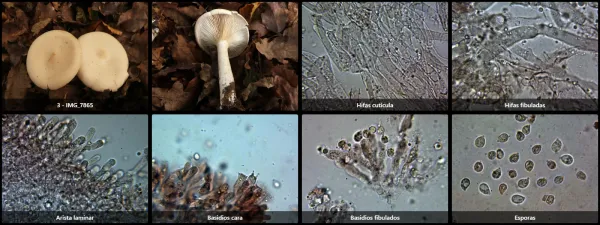
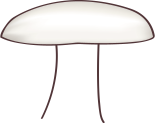
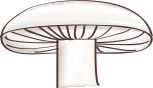
Pileus occasionally reaching 25 cm, depressed and distinctly umbonate, of uniform beige color, somewhat paler at the margin, fleshy, with a regular edge.
Lamellae crowded, prominently decurrent on the stipe, whitish to pale ochre.
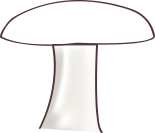
Stipe slightly clavate, very hard and fibrous, central relative to the pileus, and concolorous with it or slightly paler.
Flesh rather whitish, tough and firm, excessively fibrous in the stipe, rendering it discarded upon collection. With a cyanide-like odor and sweet taste.
Habitat:
Appears in autumn in mountain meadows, although we collect it annually under pines, where it occurs massively in fairy rings whose mere sight is astonishing; in some instances, yields can reach up to 30 kg.
Observations:
Once the stipe is discarded, the "platera" proves to be a good edible, with a pleasant flavor and ideal for accompanying stews. Clitocybe maxima, formerly separated as an independent species, is nothing more than an adult and flattened form of the same species. Leucopaxillus candidus also bears some resemblance, although it is whiter than the platera, and confusion is not hazardous given that it is an edible species. Clitocybe gibba or Paralepista flaccida also share certain similarities, although they are smaller species.